
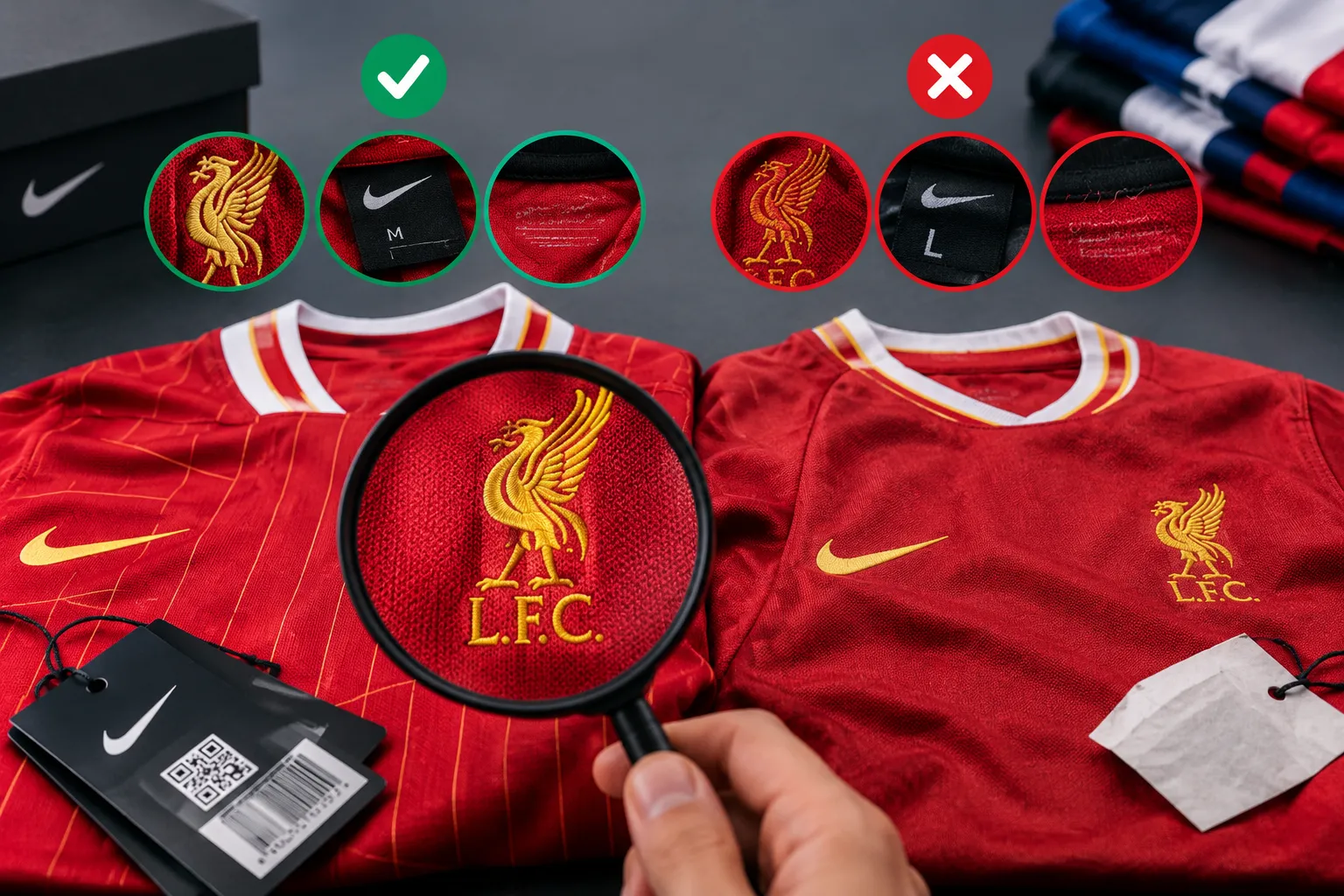
The useful thing to understand about counterfeit football shirts is that “fake” covers an enormous range. At one end is a shirt that looks wrong from three metres away, with the stripes printed on and the badge a coloured blob. At the other are shirts good enough that experienced collectors have to check the labels. Both are counterfeit, and the checks that catch the first will not catch the second.
This page collects every test that actually works, in the order worth running them, and links to the detailed guide for each. If you are about to buy from a seller you do not know, this is the page to read first.
Why counterfeits are harder to spot than they used to be
Because the industry behind them is organised and tiered. The cheapest tier takes a generic blank in the base colour and applies everything else on top — pattern, crest, sponsor, trim — as transfers. The middle tier starts from a shirt knitted to roughly the right specification with an embroidered badge. The top tier is made with access to the real specification, in similar fabric with correct trims, and is sold near retail price as genuine.
Most buyers will only ever meet the first two, which is good news, because both fail on construction. Our breakdown of how counterfeit football shirts are made explains the tiers and where each one breaks down. The Intellectual Property Office is the UK body responsible for this area and publishes guidance on counterfeit goods.
Check construction before appearance
This is the single most important principle on this page. Appearance is the easiest thing for a counterfeiter to get right and construction is the hardest, so any test based on what the shirt looks like in a photograph is the weakest test available.
Construction means how the pattern is made, how the panels are cut and joined, how the neck is finished, how the badge is attached and how the labels are sewn in. All of those cost money and tooling, and all of them are visible to anyone who knows to look.
The pattern test
If the shirt has stripes, hoops, a shadow pattern or any woven design, this takes two seconds and is close to decisive. Stretch a dark area of the pattern gently between two fingers. On a genuine shirt the colour is knitted into the fabric and stays solid. On a counterfeit it is printed onto a pale base, and the colour thins while the base shows through.
Then check alignment. Where the front panel joins the side, and where the body joins the sleeve, the pattern should continue without a step. Fakes assembled from pre-printed panels almost always jump at one of those seams, usually under the arm where the maker assumed nobody would look.
Our Newcastle verification guide works both tests on the hardest pattern in English football to copy, and the method transfers to any striped or hooped shirt.
The crest
Club badges are detailed, and fine detail is what cheap embroidery destroys. On a genuine shirt the individual elements inside the crest are distinct and the outlines are crisp. On a fake the stitching is dense and slightly raised, and the detail reads as a blur at arm’s length.
Position matters as much as quality. A badge should sit in a specific place relative to the centre line and to any pattern, and counterfeits routinely place it a centimetre or two out, or centre it on the wrong stripe. Compare against an official product photograph of the same season rather than against memory.
How do you check the printing and the patches?
These are the components counterfeiters find hardest to source, which makes them the most reliable indicators on a well-made fake.
Lettering first. Each competition has an official font, produced to a specification by a licensed supplier, and the digit shapes are distinctive enough that a near-match is obvious once you have seen the real one next to it. Our guide to how shirt number fonts are chosen explains why they are so specific. Application matters too: official printing is a thin, flexible heat transfer that sits nearly flush with the fabric, while a fake usually uses thicker vinyl you can feel as a raised plastic layer.
Then sleeve patches. Competition badges are licensed separately, made to a set specification and applied in a fixed position. A patch that is slightly the wrong size, the wrong shade or marginally crooked is a strong signal.
And the sponsor. Sponsor logos are reproduced to brand guidelines on genuine kit, so the proportions and the exact colour are consistent across every shirt in a run. How football shirt sponsorship works covers the deals behind them, and how kit supplier deals work explains why the licensed components are controlled so tightly.
Labels and the inside of the neck
Turn the shirt inside out, because this is where most fakes fall apart. A genuine shirt has a neatly finished neck tape, cleanly overlocked seams, and labels stitched in squarely with legible printing. The size label, the care label and any supplier product code should all be present and consistent with one another.
Mismatches are the giveaway. A counterfeit frequently pairs a size label from one season with a care label from another, or carries a product code that does not correspond to the shirt in front of it. Suppliers change their internal labelling regularly, which makes a genuine shirt’s labels a reliable fingerprint of its year.
Children’s kit has its own labelling conventions and its own common errors, covered in kids’ football kit sizing and labels.
Club by club verification
The general tests work everywhere, but each club’s shirt has specific details worth knowing before you buy. The detailed guides:
Tottenham, where a plain white shirt leaves nowhere to hide a construction fault. Chelsea, one of the most widely copied ranges in the league. Manchester United, the most copied of all. And Leeds, which covers reproductions rather than fakes — a different problem with a different set of checks.
For international kit, the England football kit specification guide sets out what the official specification actually requires, which is the baseline any genuine shirt has to meet.
What about replicas, player versions and the tiers?
A great deal of suspected counterfeiting turns out to be a buyer comparing two genuine shirts from different tiers. The entry replica, the mid-tier and the player or authentic version differ in cut, fabric, seam construction and badge application, and a replica held next to a player shirt looks like a worse version of the same thing because in several respects it is.
Knowing the differences prevents a false positive. Replica versus player version sets them out side by side, and how the replica kit market works explains the release cycle, the discounting pattern and why the same shirt can be two very different prices in the same month.
How do you judge a seller?
Treat the seller as part of the product, because with an unknown seller you are buying the shirt and the recourse together. What you want is photographs of the actual item rather than stock images, at least one showing the inside of the neck, a clear returns policy, a trading history and a willingness to answer a direct question about the labels.
Price is a signal but a weaker one than people assume. A brand-new current-season home shirt at a large discount is unusual, because pricing is controlled while a kit is current — but a season-old away shirt at half price is completely normal. Our seller checks for buying shirts online covers the questions worth asking before you commit.
Anyone shopping for football shirts online uk should treat the returns policy as the most important line in any listing. Every other mistake on this page is recoverable if the return is.
Retro, tribute and the legal grey area
Not everything unofficial is counterfeit, and for retro buyers the distinction matters. A large number of vintage-style shirts are sold as tributes rather than reproductions: correct colours, correct era, correct pattern, but no club crest, no sponsor and no supplier branding. Those are legal products and some are very well made, because the maker is competing on fabric and construction rather than on a badge.
What makes a shirt counterfeit is the use of the marks — crest, club name, supplier logo, sponsor. A tribute shirt that adds a club badge has crossed that line whatever the listing says, and a seller who will add one on request is selling counterfeits. For the designs people most want reproduced, when Premier League kits became football icons covers the shirts with the strongest following.
Looking after a genuine shirt
Most shirts are ruined in a laundry basket rather than on a pitch. Heat lifts printing and badges, fabric conditioner destroys the moisture handling, and a tumble dryer does both at once. Wash inside out at thirty degrees with liquid detergent and no conditioner, and air dry away from direct heat.
How to wash and store football shirts covers the full routine, including mud, grass, long-term storage and what to do when a printed number starts to lift.
Elsewhere on the site
For kit history rather than verification: why goalkeepers wear different colours, how football boots changed the game, and how the women’s shirt market grew up.
Three club pieces worth an evening: Newcastle’s number 9 and the stripes, Everton from Dixie Dean to the new stadium, and Hull City’s Premier League memories.
And on the football itself: what makes a great Premier League midfielder, why home advantage still matters, why Arsenal versus Chelsea is one of London’s biggest rivalries, and the tactical breakdown of Anfield’s high press.
Frequently asked questions
What is the quickest way to spot a fake football shirt?
Stretch a dark area of the pattern. If the colour thins and a pale base shows through, the pattern is printed rather than knitted, which means it is not an official shirt.
Can a counterfeit have correct-looking labels?
Better fakes copy them closely. The usual failure is internal consistency a size label, care label and product code that do not all belong to the same season.
Is it illegal to buy a fake football shirt in the UK?
Buying for personal use is not generally prosecuted. Selling counterfeit goods, or importing them in commercial quantities, is a criminal offence.
Does a low price always mean a fake?
No. A current-season home shirt heavily discounted is unusual and worth checking carefully, but a season-old away or third shirt at half price is entirely normal that is how the market works.