
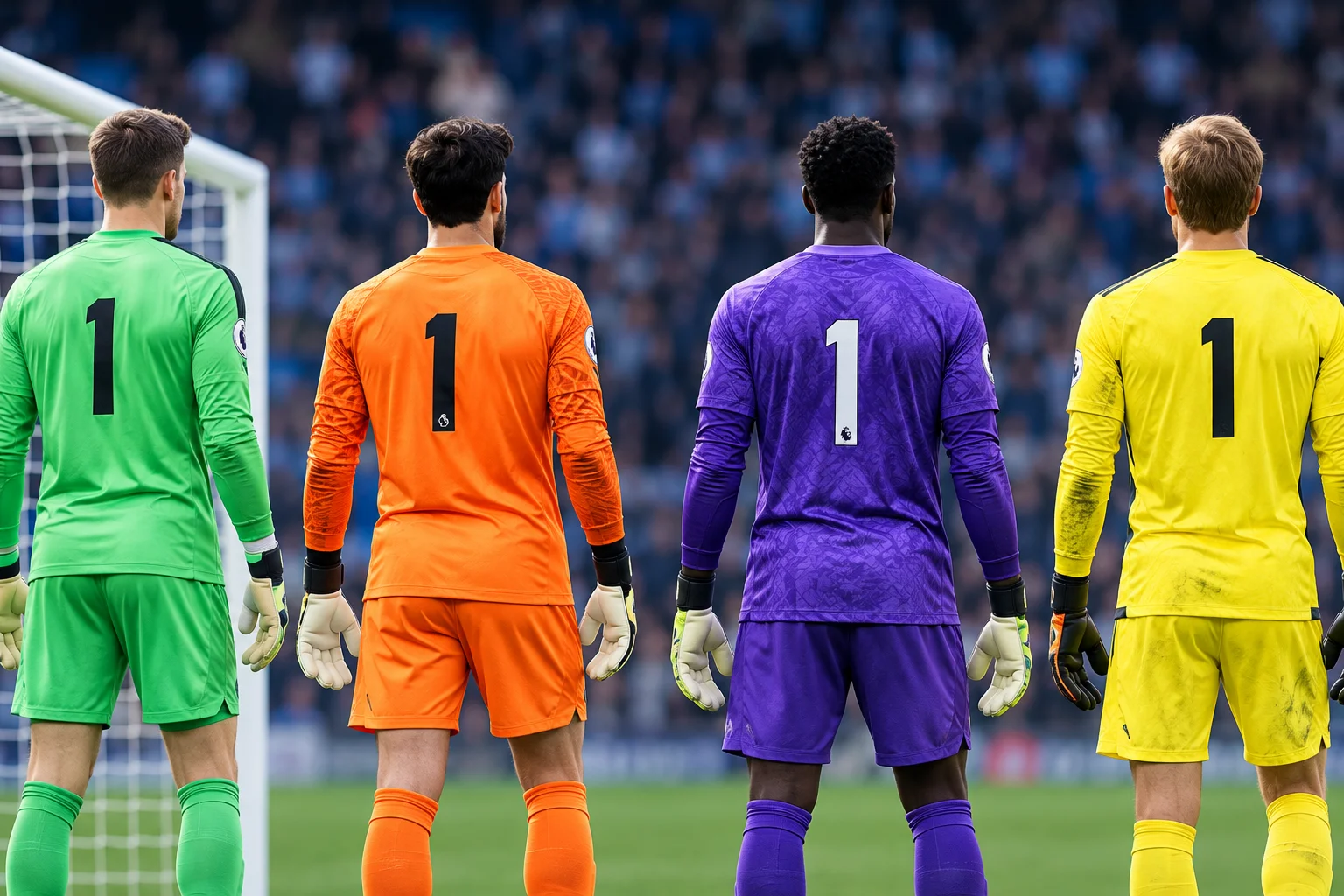
On a football pitch, twenty of the twenty-two players are dressed to match their teammates. The other two are dressed to stand out from everyone. Goalkeepers wear colours that set them apart from their own side, from the opposition and from the match officials, and the reason is one of the most practical rules in the game.
It also means goalkeeper shirts follow a different set of design rules from outfield kits, which has made them one of the more interesting corners of kit history.
What does the rule actually say?
The Laws of the Game require each goalkeeper to wear colours that distinguish them from the other players and from the match officials.
The goalkeeper is the only player allowed to handle the ball, and only within their own penalty area. For that to work, the referee needs to identify the goalkeeper instantly, especially in a crowded goalmouth when several players are close to the ball. A goalkeeper dressed like the outfield players would make that far harder and lead to mistakes.
So the rule exists to make the game easier to officiate. The goalkeeper’s distinct colour is not decoration. It is how the referee knows at a glance who is allowed to use their hands.
Were goalkeepers always dressed differently?
Not in the earliest days of the game.
In early football, goalkeepers often wore the same shirts as their teammates, sometimes with a cap or other small item to mark them out. As the game grew and the goalkeeper’s role became more clearly defined, the need to identify them easily became obvious, and rules requiring distinct colours came in during the early twentieth century.
For many years goalkeepers tended to wear a small range of colours, with green becoming especially common in Britain. Over time the palette widened considerably as manufacturers began to treat the goalkeeper kit as a design opportunity rather than a practical afterthought.
Why does the colour change from match to match?
Because the goalkeeper has to stand out from both teams.
A goalkeeper’s colour cannot clash with their own side’s outfield kit, the opposition’s outfield kit or the other goalkeeper’s colours, and it has to be distinguishable from the referee. Depending on who a team is playing, the colour that worked last week may not work this week.
This is why clubs produce several goalkeeper kits in different colours each season. It gives them options for every combination of opponents and ensures the goalkeeper can always be identified clearly.
How are goalkeeper shirts made differently?
In several ways, because the job is different.
Goalkeepers spend much of the match diving, landing on hard ground and making contact with the ball, the posts and other players. Their shirts are usually made with more padding at the elbows and sometimes the shoulders to protect them from impact. Long sleeves are common, partly for protection and partly for warmth, since goalkeepers stand still for long periods.
The fabric often needs to be tougher than an outfield shirt’s, since it takes more abrasion from diving. Some goalkeepers also prefer a slightly closer fit so the shirt does not catch or get in the way when they stretch for the ball.
Why do goalkeepers also wear gloves?
Grip and protection, and the gloves have developed as much as the shirts.
Early goalkeepers often played bare-handed. Modern gloves use specialist grip surfaces that help catch and hold a fast-moving ball, especially in wet conditions, and padding that protects the fingers and palms from the force of shots. Many also include supports that reduce the risk of finger injuries when making saves.
Gloves have become as much a part of a goalkeeper’s kit as the shirt, and goalkeepers are often particular about the exact model they wear.
Goalkeepers also tend to wear tracksuit-style trousers in cold or wet conditions, particularly at lower levels of the game, which outfield players never do. It is another sign that the goalkeeper’s kit has always followed its own practical logic.
Why have goalkeeper kits become collectable?
Partly because they were made in far smaller numbers.
Replica goalkeeper shirts sell in much smaller quantities than outfield shirts, because fewer supporters buy them. That scarcity means older goalkeeper kits are harder to find years later. And because designers treated the goalkeeper kit as a place to experiment with bold colours and patterns, some of the most striking shirts ever produced were made for goalkeepers.
Those two things together, scarcity and bold design, have made certain goalkeeper shirts genuinely sought after by collectors.
What happens when an outfield player goes in goal?
The colour rule still applies, which is why you see it handled so carefully.
If a goalkeeper is sent off or injured and the team has no substitutes left, an outfield player must take their place. That player has to wear goalkeeper colours, so they pull on a goalkeeper shirt, often borrowed from the injured keeper or the spare kit on the bench. It can look slightly odd, but it keeps the referee able to identify who can handle the ball.
The same applies whenever a team swaps its goalkeeper for any reason. The switch has to be made with the referee’s knowledge, and the new goalkeeper must be clearly marked out.
Do referees have to change colours too?
Yes, and for the same reason.
Match officials also need to be distinguishable from both teams and both goalkeepers, so referees have kits in several colours and choose one to suit each match. On a day when both teams and both goalkeepers are wearing different colours, finding an option that clashes with none of them can take some thought.
It is a small detail, but it shows how much of kit design is driven by the need for everyone on the pitch to be told apart at a glance.
What does this mean for the laws of the game?
It shows how the rules shape even the smallest details of the kit. The IFAB, which writes the Laws of the Game, sets the requirement for goalkeepers to be distinguishable, and every goalkeeper kit ever produced exists to meet it. A rule written for the referee’s benefit ended up creating a whole category of football design.
For the manufacturers who design all of these kits, our piece on how football kit supplier deals work explains the business side. And for international kits, where goalkeeper colours sit alongside a very different set of rules, our England football kit specification guide covers what changes.
Next time a goalkeeper takes the field in a colour that seems to have no connection to their club, it is worth remembering that the choice was probably made to avoid clashing with four other kits at once.
Frequently asked questions
Why do goalkeepers wear a different colour?
The Laws of the Game require it so the referee can instantly identify the goalkeeper, the only player allowed to handle the ball within their own penalty area.
Why do goalkeepers change colours between matches?
Their colour must not clash with either team’s outfield kit, the other goalkeeper or the referee, so clubs produce several goalkeeper kits and choose one to suit each match.
Why do goalkeeper shirts have padding?
Goalkeepers dive and land on hard ground repeatedly, so their shirts often include padding at the elbows and shoulders to protect them from impact.