
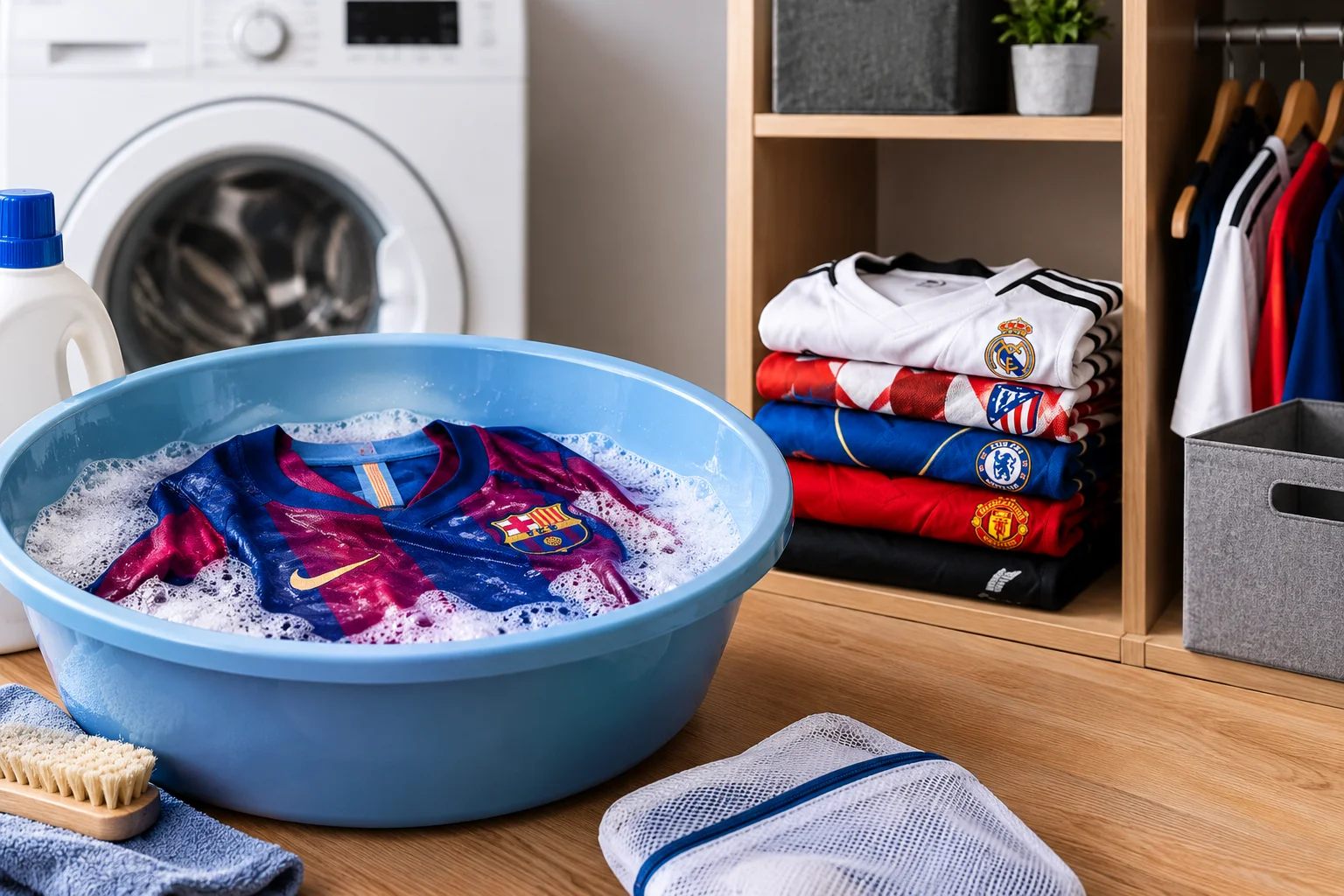
A modern football shirt is a technical garment, and most of them are destroyed by ordinary laundry habits rather than by wear. Printed numbers crack, badges lift, colours fade unevenly and the fabric stops moving sweat the way it is supposed to — usually within a year, and usually because of how the shirt was washed and dried rather than how it was used.
None of the care involved is difficult. It is mostly a matter of knowing which three or four things actually cause the damage.
What actually ruins a football shirt?
Heat, in every form. Hot water softens the adhesive behind heat-pressed numbers and badges, which is what makes them lift at the edges. A tumble dryer does the same thing faster and adds mechanical stress. An iron placed directly on a printed number will destroy it in seconds, and a radiator will do it slowly.
Fabric conditioner is the second culprit, and the least obvious. Conditioner works by coating fibres, which is the opposite of what a moisture-wicking fabric needs. A few washes with conditioner and a technical shirt stops moving sweat away from the skin and starts holding it, which is exactly the behaviour the fabric was engineered to avoid.
The third is harsh detergent and bleach, including the optical brighteners in many biological powders. These attack dyes unevenly and are particularly hard on dark colours and on the white areas of a striped or hooped shirt, where any yellowing shows immediately.
The routine that works
Turn the shirt inside out before washing. This protects the printing and the badge from abrasion against the drum and against other garments, and it puts the sweat-facing side of the fabric in direct contact with the water, which is where the cleaning is needed.
Wash at thirty degrees, on a normal cycle, with a liquid detergent and no conditioner. Liquid is gentler than powder because powder granules are abrasive and do not always dissolve fully at low temperatures. Wash shirts with other soft items rather than with jeans or anything with a zip.
Then air dry, away from direct heat and out of strong sunlight. Hang the shirt on a plastic hanger rather than a wire one, or lay it flat. A technical fabric dries in an hour or two indoors, so there is rarely any reason to use a dryer.
How do you deal with mud and grass?
Let it dry first, which is counterintuitive and correct. Dried mud brushes off; wet mud gets pushed into the weave by scrubbing. Once the bulk is off, soak the shirt in cool water with a liquid detergent for an hour before washing normally.
Grass stains are a dye rather than a soil, and they need a different approach. A small amount of detergent worked gently into the stain and left for twenty minutes before washing deals with most of them. Avoid bleach on anything coloured and avoid hot water, which sets the stain rather than lifting it.
Blood, which comes up more often than people expect in football, should be rinsed in cold water immediately. Hot water cooks the protein into the fibre and makes it permanent.
Storing shirts properly
For shirts in regular use, folding is better than hanging. A heavy shirt left on a hanger for months stretches at the shoulders, and the cheap plastic hangers that come with kit leave marks. Fold with the printing on the outside of the fold rather than the inside, so the numbers are not creased against themselves.
For shirts you want to keep long term, the enemies are light, damp and pressure. Store them folded in a drawer or a box, out of sunlight, somewhere that does not get damp — not a loft, which goes through large temperature swings, and not a cellar. Interleave tissue paper between folds if the shirt is old or valuable, and refold it occasionally so the creases do not set.
Framing is popular and is fine as long as the glass is UV-filtering and the frame is not in direct sun. An unframed shirt pinned to a wall in a sunny room will fade visibly within a year, and the fade is not recoverable.
Dealing with smell
Technical fabrics hold odour in a way cotton does not, because the bacteria responsible bind to synthetic fibres more readily. Washing at thirty degrees does not always clear it, which is why a shirt can come out of the machine smelling clean and then smell again the moment it warms up.
The fix is not a hotter wash. Rinse the shirt in cold water as soon as possible after wearing it, so the sweat does not dry into the fabric, and wash it the same day rather than leaving it in a bag. For a shirt that has already developed a persistent smell, a soak in cool water with a cup of white vinegar for an hour before a normal wash deals with most cases, and a sports-specific detergent designed for synthetics deals with the rest.
What makes it worse is fabric conditioner, for the same reason it harms the wicking: the coating it leaves traps the bacteria it is supposed to mask.
Looking after prints and badges
If a printed number starts to lift at a corner, stop washing the shirt until you deal with it, because each wash will take more. A low-heat iron over a tea towel, pressing firmly for a few seconds, will often re-bond it. Never apply an iron directly to the print.
Embroidered badges need less care but do pull threads, usually from contact with Velcro or zips. Washing the shirt inside out solves most of this. If a thread does pull, cut it rather than pulling it through, which tightens the surrounding stitching.
Retro reproductions made from heavier fabrics tolerate washing better than modern technical shirts but shrink more, so keep them well away from heat in every form. For older shirts in a collection, less washing is better than more — airing after wear deals with most of it. If you are checking a shirt’s authenticity before adding it to a collection, our guide to spotting a fake Newcastle shirt sets out the checks that matter.
Frequently asked questions
What temperature should I wash a football shirt at?
Thirty degrees, with a liquid detergent and no fabric conditioner. Higher temperatures soften the adhesive behind printed numbers and badges.
Can I put a football shirt in the tumble dryer?
No. Heat and mechanical stress together are the fastest way to lift printing and degrade a technical fabric. Air dry away from radiators and direct sun.
Why should I avoid fabric conditioner?
It coats the fibres, which stops a moisture-wicking fabric from moving sweat away from the skin. A few washes with conditioner can permanently reduce how the shirt performs.
How should I store a shirt I want to keep?
Folded, in a drawer or box, away from light and damp, with the printing on the outside of the fold. Refold it occasionally so creases do not set, and avoid lofts and cellars. Where the shirt came from in the first place is worth knowing too, and how the replica kit market works explains the pricing cycle.