
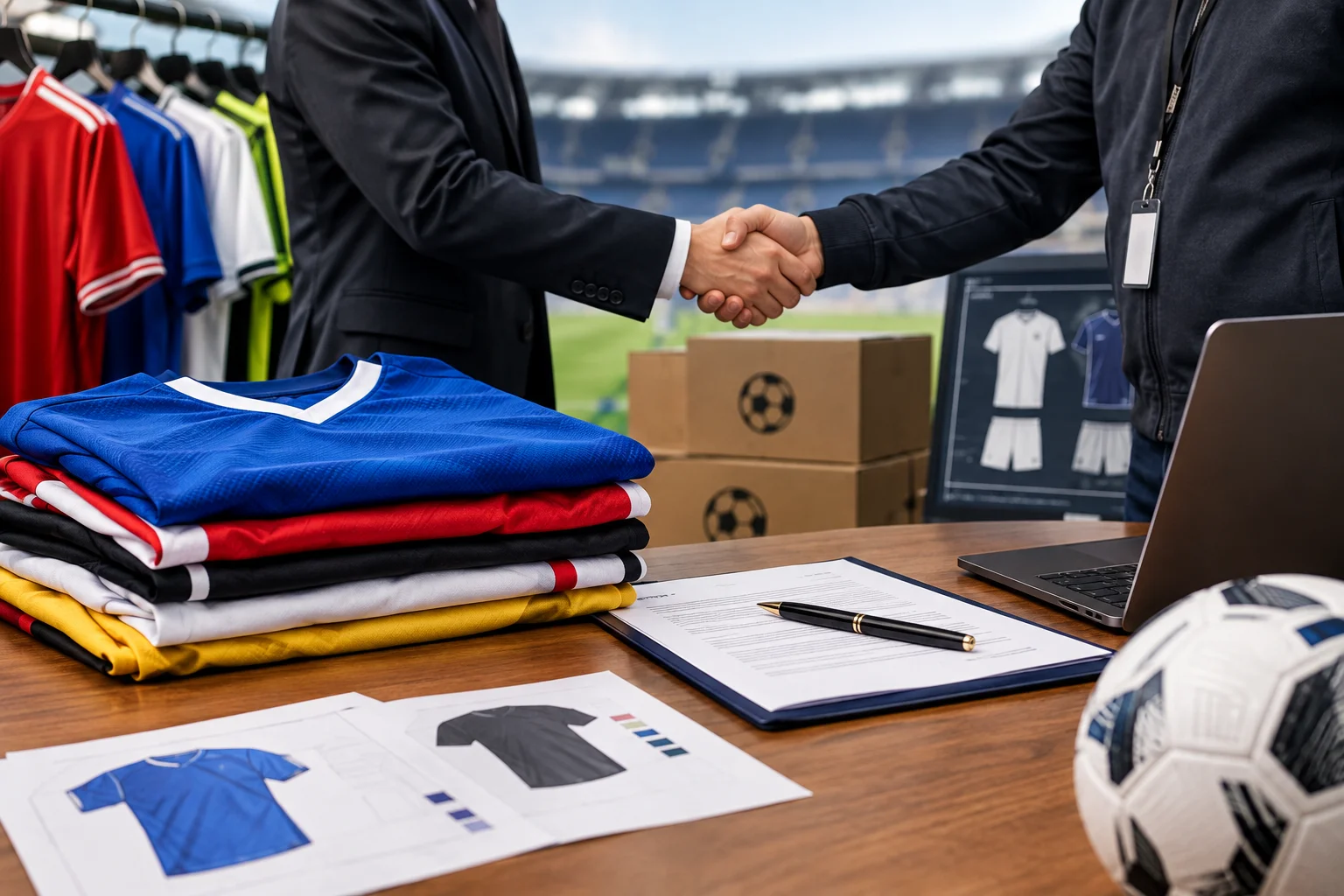
The manufacturer’s logo sits on the chest of every football shirt, opposite the club crest, and most supporters barely notice it. Yet the deal behind that small logo is one of the most important commercial agreements a club signs, and it shapes almost everything about the shirts fans end up buying.
Understanding how these deals work explains why kits change when they do, why some clubs switch manufacturers and others stay loyal for decades, and why the price of a shirt is what it is.
What is a kit supplier deal?
It is an agreement that gives a sportswear company the right to make and sell a club’s official kit.
In return, the manufacturer does two main things. It supplies the kit the club actually wears, for the first team and often for the youth sides and staff. And it pays the club, sometimes a very large amount, for the right to put its name on the shirt and sell replicas to supporters.
That payment is the surprising part for many fans. The manufacturer is not simply being paid to make shirts. It is paying for access to the club’s supporters and to the exposure that comes with a famous team wearing its logo in front of millions.
Why do manufacturers pay so much?
Because a famous club’s shirt is enormous advertising and a large business in its own right.
Every match televised around the world shows the manufacturer’s logo on the players’ chests. Replica sales to supporters can run into huge numbers for the biggest clubs, and the manufacturer takes a share of every one. There is also the prestige of being associated with a successful team, which helps sell the manufacturer’s other products.
For the biggest clubs, these deals are among the most valuable agreements they sign. For smaller clubs, they are more modest, and a manufacturer may supply kit in exchange for a smaller fee or a share of sales rather than a large guaranteed payment.
How long do the deals last?
Usually several years, and often longer for the biggest clubs.
A multi-year deal gives both sides stability. The manufacturer can plan several seasons of designs and invest in marketing, knowing the partnership will last. The club gets guaranteed income it can build into its budget.
When a deal ends, the club can renew with the same manufacturer or move to a rival. A switch usually produces a noticeable change in the look of the kit, because each manufacturer has its own design style, its own templates and its own way of cutting a shirt.
Who decides what the shirt looks like?
It is a negotiation, and the balance varies.
The manufacturer designs the kit, usually working within its own templates and house style for that season. The club has a say, particularly on anything touching its identity: the colours, the crest and elements supporters care about. The biggest clubs have considerable influence. Smaller clubs often accept more of the manufacturer’s standard designs.
This is why kits from different clubs on the same manufacturer in the same season often share a collar, a sleeve design or a pattern. They are built on the same template, with each club’s colours and details applied to it.
How does the deal affect the price of a shirt?
It is one of the main reasons shirts cost what they do.
When a manufacturer pays a club heavily for the right to sell its kit, that cost has to be recovered, and much of it comes back through replica sales. The price of an official shirt therefore reflects not just the cost of making it but the value of the deal behind it, plus marketing, distribution and the retailer’s margin.
The materials and construction are a relatively small part of the total. That is the gap in which cheaper replicas sit, since they do not carry the licensing cost of the official deal.
Why does the manufacturer matter when dating a shirt?
Because the manufacturer’s logo is one of the most reliable clues to when a shirt was made.
Supplier deals run in blocks of years, so knowing which company made a shirt places it within a defined window. Combined with the club’s sponsor, which runs on its own cycle, and the crest, the manufacturer narrows a shirt down to a small range of seasons. For international shirts, which have no sponsor on the front, the manufacturer becomes the single most useful marker of all.
Collectors pay close attention to this, and a manufacturer logo that does not match the season a shirt claims to be from is one of the clearest signs something is not right.
What else does the manufacturer supply?
Far more than the match shirts, which surprises many supporters.
A kit deal usually covers training wear, warm-up tops, travel clothing, the jackets players wear to and from the ground, and equipment for the staff. The manufacturer’s logo appears on all of it, which is part of what the company is paying for. Every television interview, training photograph and arrival at a stadium puts its brand in front of fans.
For supporters, this is why the same manufacturer’s name appears across a wide range of club clothing, not only the replica shirt.
How do supporters react to a change of manufacturer?
Strongly, at times, because a new manufacturer changes how the club looks.
Each manufacturer brings its own house style, its own cut and its own approach to design, so a switch can produce kits that feel very different from what came before. Supporters used to one manufacturer’s look sometimes take time to accept a new one, and the first season after a change is often the one fans argue about most.
For collectors, a change of manufacturer is useful, because it creates a clear dividing line in a club’s kit history.
Do clubs ever make their own kit?
Occasionally, though it is rare at the top level.
A handful of clubs have tried producing kit under their own brand, which lets them keep more of the income and control the design completely. The difficulty is that they lose the manufacturer’s payment, its design expertise and its worldwide distribution network. For most clubs, a partnership with an established manufacturer makes more sense.
For the verification side of all this, our guide to the authentication checks on Manchester United shirts covers how the manufacturer mark helps confirm a shirt’s season. And for the one player whose kit follows completely different rules, our piece on why goalkeepers wear different colours explains the reasons.
Frequently asked questions
Do kit manufacturers pay football clubs?
Yes. At most professional clubs the manufacturer pays for the right to make and sell the official kit, and for the biggest clubs these deals are among their most valuable commercial agreements.
How long do kit deals usually last?
Typically several years, and often longer for the largest clubs. Multi-year deals give the manufacturer time to plan designs and the club guaranteed income.
Why do kits from different clubs look similar?
Manufacturers build a small number of templates each season and apply each club’s colours and details to them, so clubs on the same manufacturer often share collars, sleeves and patterns.