
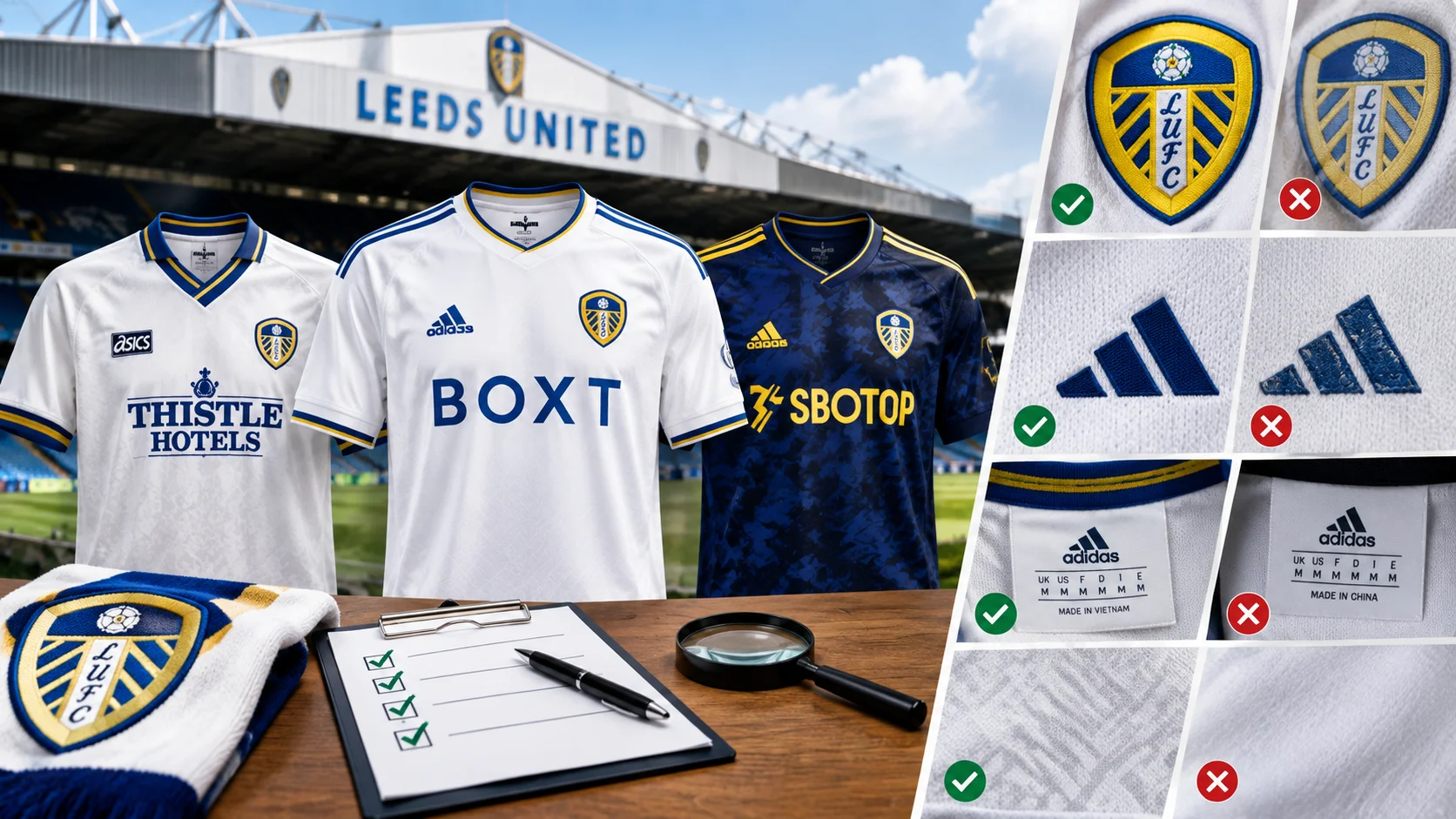
Reproductions of classic kits are a large and mostly legitimate part of the market. Plenty of people want to wear a design from a season they remember without paying what an original in wearable condition costs, and a well made reproduction serves that perfectly.
The problem is that reproduction quality varies enormously, and on a plain white kit there is nowhere for a poor one to hide. Judging them is a different exercise from judging a current season shirt.
Why is a white kit harder to reproduce?
Because the entire garment is one surface with nothing to distract the eye.
On a patterned or multi colour shirt, small inconsistencies in fabric weight, dyeing and finish get lost in the visual noise. On plain white every one of them is visible. Panel differences show at the seams. Thin areas in the knit show against light. Any yellowing or grey cast shows immediately.
That makes leeds united kits an unusually honest test of a reproduction. If the white is even, opaque and consistent across every panel, the manufacturer has taken care. If it is not, they have not, and that carelessness will show elsewhere too.
What should you check on the fabric?
Opacity first. Hold the shirt to a light source. A quality reproduction should not be translucent enough to read shapes through. If it is, the knit is lighter than it should be and the shirt will look thin and age quickly.
Then weight in the hand. Reproductions of older kits should feel heavier than a modern performance shirt, because the originals were. A reproduction of a 1970s or 1980s shirt made from a light modern knit is not really reproducing anything except the graphics, which may be fine for your purposes but is worth knowing.
Then panel consistency. Lay it flat and compare white against white at the sleeve, the body and any side panels. They should be indistinguishable.
How do you judge the badge?
The badge is where most reproductions reveal their price point, and it is also the element that varies most across the club’s history.
The crest has gone through several genuinely distinct versions rather than subtle redraws, changing shape, content and style substantially. A reproduction claiming a particular era should carry the badge from that era, and a mismatch there is the clearest possible sign the shirt is not what it says.
Then construction. Embroidered badges on reproductions of older shirts are appropriate, since that is how they were made. A heat pressed badge on a reproduction of a shirt from a period when badges were stitched is anachronistic, and it will lift at the corners within months regardless.
What about the yellow and blue accents?
They are small areas of strong colour against white, which makes them prominent out of proportion to their size and demanding to produce.
Check the boundary between the accent colour and the white. It should be sharp. Softness, fuzzing or any colour cast bleeding into the white means unstable dye, and unstable dye keeps transferring in the wash. On a predominantly white shirt that is a progressive problem.
Also check the accents are the right shade for the claimed era. The specific yellows and blues used have shifted across the decades, and a reproduction using current trim colours on a design from thirty years ago has not been researched properly.
Does the collar construction help?
It is one of the more reliable era markers on a reproduction, and it is often overlooked.
Collar construction has changed substantially over the decades. Older shirts used separate collar pieces attached with visible topstitching. Later eras moved to ribbed knit collars, then to bonded and moulded constructions on modern shirts.
A reproduction claiming to be from a period when collars were separately constructed, but using a modern moulded collar, has reproduced the graphics rather than the garment. Whether that matters depends on what you want it for, but it is worth identifying before paying a premium for authenticity that is not there.
How do you tell a reproduction from an original?
Construction detail rather than appearance, and this matters when a listing is ambiguous about which it is selling.
Fabric weight is the broadest separator. Heavy cotton belongs to one era, early polyester to another, modern engineered knits to a third, and they are easy to distinguish by touch. Label construction is the second, since woven, printed and heat transferred care labels each belong to broad periods.
Stitching method is the third. Older shirts were constructed differently from modern ones, with different seam types and different thread. Reproductions rarely replicate these exactly, because doing so would cost more than the market supports.
Does a reproduction hold any value?
Some, but it is a different market from originals and should not be confused with it.
Well made reproductions of famous kits hold modest value and are perfectly saleable. They do not appreciate the way scarce originals can, because they can be made again. That is not a criticism, simply a different proposition.
The practical point is to know which you are buying. A listing that is vague about whether a shirt is original or reproduction is worth clarifying before purchase rather than after, and a seller who will not answer directly has told you something.
How should you care for one?
Cool wash at thirty degrees, inside out, with other whites rather than in a mixed load. White polyester takes colour transfer readily and holds it.
No tumble dryer, because heat lifts badges, cracks printing and accelerates yellowing. No fabric softener, which dulls the white and coats the fibres. For a reproduction of an older cotton shirt the same principles apply with more caution, since cotton is less forgiving of heat than polyester.
The judging sequence
Opacity against light, weight in the hand, panel consistency, badge version against the claimed era, badge construction, accent colour boundaries, then labels and stitching if you are trying to separate reproduction from original.
United shirts add a further variable with the contrasting elements, and our guide to the authentication checks on cheap Manchester United shirts works through them. For a club whose kit identity rests on two strong colours instead, Hull City shirts and Premier League memories covers it.
Frequently asked questions
How do I tell a reproduction from an original football shirt?
Construction rather than appearance. Fabric weight, label construction and stitching method differ between eras in ways reproductions rarely replicate exactly, because matching them costs more than the market supports.
Why does a white reproduction show faults so clearly?
Because there is no pattern or second colour to absorb inconsistencies. Panel differences, thin knit areas and any yellowing are all visible on plain white in a way they are not on other kits.
Can collar construction date a shirt?
Yes, and it is often overlooked. Older shirts used separate collar pieces with visible topstitching, later eras used ribbed knit collars, and modern shirts use bonded or moulded constructions. A mismatch against the claimed era is telling.
Do reproduction shirts hold value?
Modest value, and they are perfectly saleable, but they do not appreciate like scarce originals because they can be produced again. It is a different market rather than a lesser one.