
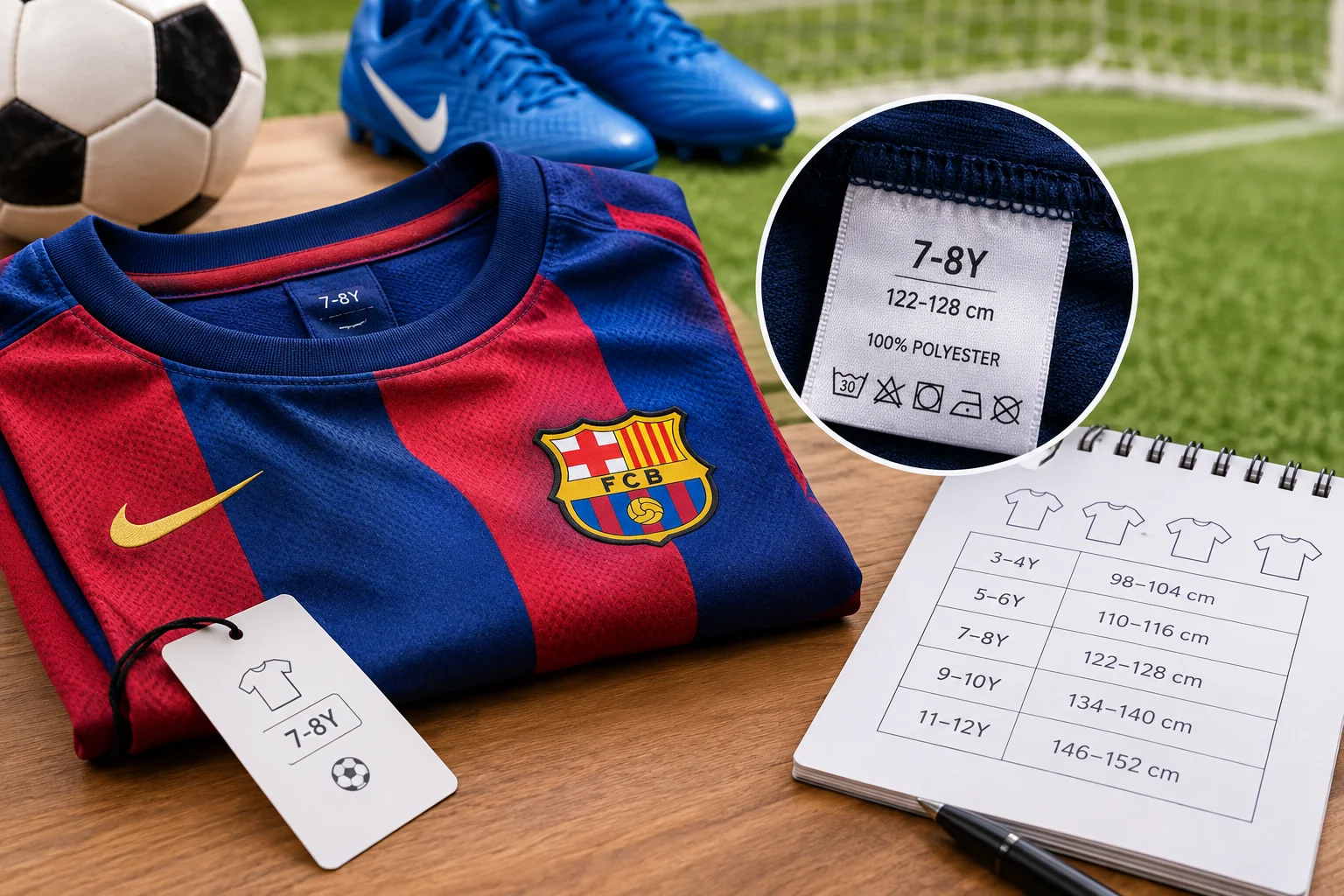
Children’s football kit is sold by age, which is the least useful measurement available. A shirt labelled for a seven-year-old is really cut for a child of a certain height, and seven-year-olds come in a range of heights that spans several sizes.
Reading the labels rather than the listing solves most of the problems parents have with kids’ kit. It also tells you a good deal about how the garment was made.
What does the age label actually mean?
A height range, expressed in a way that is easier to market.
Most children’s football shirts are labelled in age bands: five to six, seven to eight, and so on. Behind each band is a height range in centimetres, and that is what the pattern was cut to. A shirt for ages seven to eight is usually built for a child somewhere around 125 to 135 centimetres, regardless of how old they are.
So the first thing to do with any listing is find the height figure. Sellers who publish it are giving you real information. Sellers who publish only the age band are giving you a guess.
What do the sewn-in labels tell you?
More than parents usually read.
The size label inside the neck typically carries both the age band and the height range, and sometimes a chest measurement as well. The wash label tells you the fabric composition and the recommended care, which for modern kit should be cool wash and no tumble dryer. And on official kit, the labels carry the manufacturer’s product codes, which identify the specific garment and season.
Checking those labels when a kit arrives confirms you received what was described. A label showing a different height range from the listing, or a fabric composition that does not match a quality replica, is a reason to raise it with the seller.
Chest measurement, where the label gives one, is the most useful figure of all. Lay a shirt your child already wears comfortably flat on a table and measure it from armpit seam to armpit seam. If the new shirt’s label or the seller’s chart gives a chest figure, matching it to that measurement is more reliable than either the age band or the height range.
How much growing room should you leave?
One size at most, and only with a reason.
Football shirts already have room in them, and a child in a shirt two sizes too big finds it uncomfortable and stops wearing it. A shirt that fits properly for a year is a better purchase than one that fits badly for two. If your child is near the top of their current height range, or visibly about to grow, go up one size. Otherwise buy the size that fits now.
Shorts follow a separate logic, sized on waist rather than height, so a kit sold as a single size assumes both measurements line up. For many children they do not, and buying shirt and shorts separately gives a better fit.
What construction actually lasts?
Crest attachment above everything, because children’s shirts have a hard life.
A child’s shirt is played in, not just worn. It meets walls, tarmac and grass, and it goes through the wash several times a week. A heat pressed badge on a child’s shirt lifts at the corners quickly and then keeps going. An embroidered or properly bonded crest survives. When looking at kids football kits, the crest photograph is the most useful image a seller can provide.
Stitching at the hem and cuffs matters more than on adult shirts, for the same reason. Look for dense, even seams in the photographs.
What about goalkeeper kits for children?
A separate purchase, and one worth making if a child is actually playing in goal.
Children’s goalkeeper shirts are padded at the elbows and often at the shoulders, use tougher fabric than an outfield shirt, and are usually long-sleeved. A child who dives on hard ground in an outfield shirt goes through it quickly. The goalkeeper version is built for exactly that and lasts far better. Padded trousers exist for children too, and they make a genuine difference on artificial surfaces.
Should you print a name and number?
It is what makes a shirt feel like the child’s own, and it is worth doing with one caution.
Printing makes the kit non-returnable, since it has been made to order, so the sizing has to be right first. And a player’s name ties the shirt to a squad that changes. A child can be genuinely upset when the player on their back moves club. Their own name never has that problem.
Printing on children’s shirts also uses a smaller font and number size, and a seller who prints adult-sized numbers on a child’s shirt has not done it properly.
How should you wash it?
Cool, at thirty degrees, inside out, no fabric softener, no tumble dryer. With a shirt being washed three or four times a week, the damage from heat and softener accumulates far faster than on an adult shirt worn occasionally. Air drying takes little longer with polyester and roughly doubles how long the crest and printing last.
Do international and club kids’ kits differ?
In cycle rather than construction.
Club kids’ kits are replaced every season alongside the adult shirt. International kids’ kits run on the tournament cycle of roughly two years, which makes them a better long-term buy for a child who will not have grown out of it before it goes out of date. The construction is otherwise similar, though international shirts for children sometimes simplify or drop patterns that appear on the adult version.
For a child who follows both a club and the national team, the international shirt is the one that lasts longer in every sense.
What to check on arrival
Read the neck label for the height range and compare it to the listing. Read the wash label for fabric composition. Look at the crest edges for a backing outline. Measure the shirt across the chest and compare it to the chart. Five minutes, and it confirms the kit is what you paid for before your child has worn it.
For the equivalent checks on an adult international shirt, our England football kit specification guide covers the same ground.
One final thought on buying ahead. Because kids’ club kits change every season, buying the current shirt late in the season means paying full price for something soon to be replaced. Last season’s kids’ shirt, reduced, is often the better purchase, particularly for younger children who neither know nor care which season it is from. The shirt they want is the one with their club’s badge on it.
Frequently asked questions
What size football kit should I buy for my child?
Match their height to the height range on the label, not their age to the age band. Size up once at most, and only if they are near the top of their range.
Do kids’ football shirts run big or small?
Neither consistently, which is why the height range matters more than the age label. Manufacturers differ, so check the figures for each kit.
How do I make a kids’ football kit last?
Choose one with an embroidered or bonded crest, wash it cool and inside out, skip fabric softener, and keep it out of the tumble dryer.