
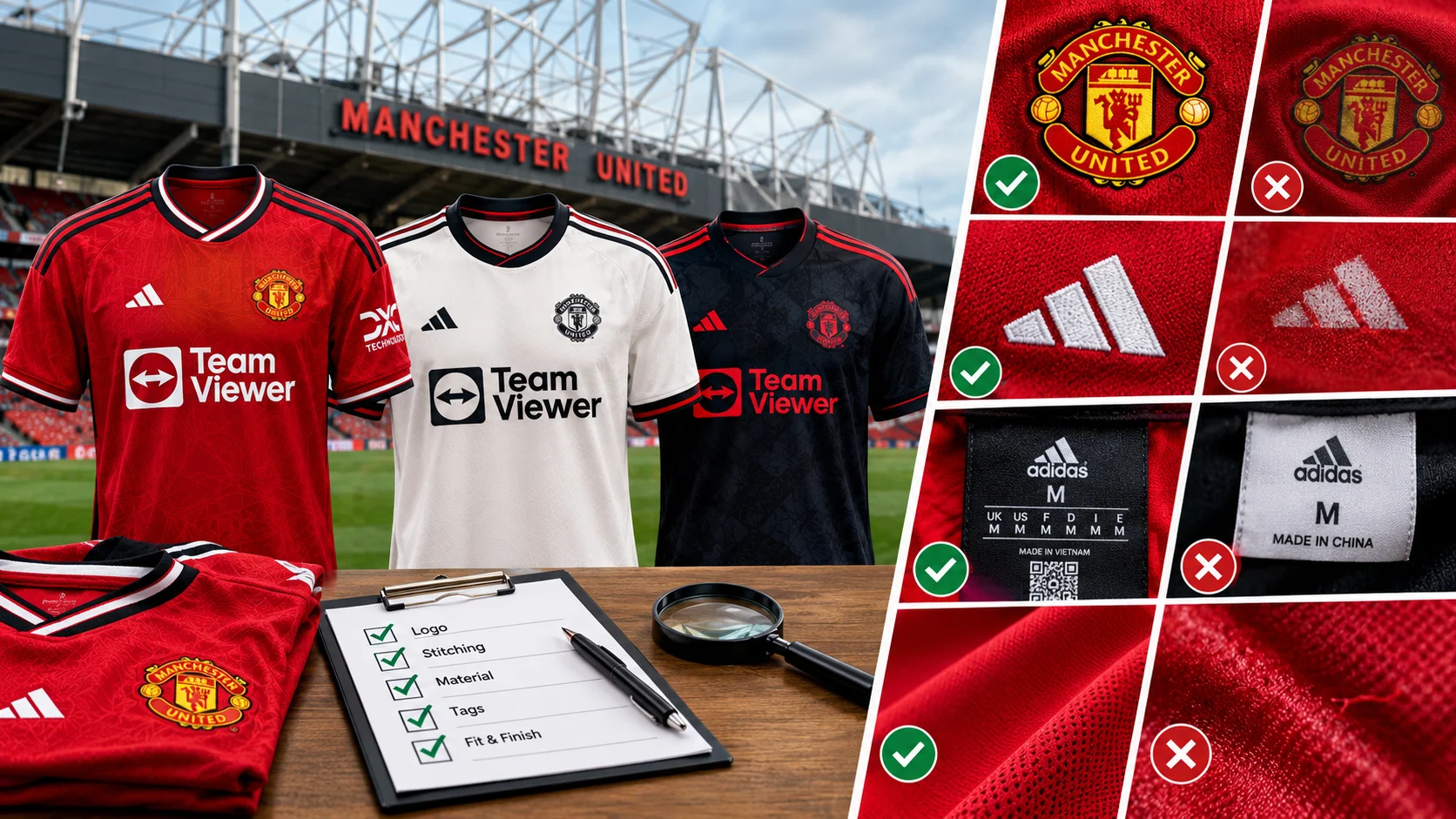
United shirts sell in larger numbers than any other English club’s, which means more sellers, more listings and more variation in what actually arrives. Most of it is fine. Some of it is not what was described, and the difference is usually detectable before you have worn the shirt.
The checks below are about matching the garment to the listing rather than about price. A shirt that costs very little and is honestly described is a good purchase. A shirt that costs more and is not is a bad one.
What does the red tell you?
More than people expect from a single colour.
United’s red has shifted across the decades as manufacturers and dye formulations changed, so shirts from different eras genuinely do not match each other. That is normal and not a fault.
What is not normal is variation inside one shirt. Compare the red at the sleeve against the red at the body, and at any panel seams. On a well made shirt they are indistinguishable. A visible difference means panels from different dye batches, which is a production shortcut and rarely the only one taken.
When assessing cheap manchester united shirts across listings, also look at whether a seller’s shade holds consistent from one product to the next. Wandering shades across a range indicate stock from mixed sources with no quality control behind it.
How do you check the crest?
The crest is the single most informative element on any shirt and the first thing to examine.
Embroidered crests show visible thread texture and sit into the fabric. Properly bonded crests sit flush with clean edges. Heat pressed badges show a faint outline where the backing film ends, and they lift at the corners within months of regular washing.
The question is not which is better in the abstract but whether it matches what was described. A shirt sold as quality replica construction with a heat pressed badge has not been accurately listed, and that is worth raising.
Also check the crest version against the claimed season. The club’s crest has gone through distinct phases, and a mismatch between badge and stated year is the clearest sign a shirt is not what the listing says.
What are the season markers?
Four, in order of how much each narrows the range.
The sponsor first, since deals run in blocks of several years and place a shirt in a window immediately. The manufacturer’s mark second, which changes on a different cycle and cross references usefully against the sponsor.
The crest version third, for the broad era. The collar fourth, which changes more often than anything else and usually separates individual seasons within a sponsorship block.
A shirt where all four agree is almost certainly what it claims. A shirt where one disagrees is worth a question to the seller before you accept it.
How do you verify the size?
Measure rather than trust the label, because labels are the easiest thing to get wrong in production.
Lay the shirt flat, smooth it out, and measure straight across from one armpit seam to the other. That half chest figure should match what the seller’s chart said for the size you ordered, within a centimetre or two of normal manufacturing tolerance.
Several centimetres of difference means either an inaccurate chart or a shirt labelled as a size it is not. Measure the body length as well, from the base of the collar to the hem, since a shirt can be correct across the chest and wrong in length.
What about printing on the back?
Printing is where a shirt’s specification is most visible and most frequently mismatched.
Official replica printing uses specific fonts that change by season and by competition, and those fonts are documented well enough that a mismatch is identifiable. A shirt printed in a font that does not correspond to the claimed season is not what it says it is.
Printing also affects your options. A printed shirt is made to your specification, which removes the automatic right to cancel under distance selling rules. That makes getting the size right before ordering considerably more important than it would otherwise be.
What about the neck and wash labels?
Supporting evidence rather than proof, but useful when other markers are ambiguous.
Neck labels, size labels and wash care tags have changed construction repeatedly. Woven labels, printed labels and heat transferred care instructions each belong to broad periods, and a label style that does not match the claimed era is worth querying.
Labels are also where shirts are most often modified after the fact, either removed for comfort or replaced. A shirt with cut or missing labels is not automatically suspect, since plenty of people remove scratchy neck labels, but it does remove one of your verification routes and should factor into what you are willing to pay.
What should the fabric feel like?
Appropriate to the claimed era, which is a broad but reliable test.
Modern replica construction uses a light engineered knit with visible texture, often with a more open structure across the back. Player version construction is lighter again, with more aggressive ventilation and frequently bonded rather than stitched seams.
A shirt sold as a player version that has conventional stitched seams and replica weight fabric is a replica. That is a specification mismatch rather than a quality problem, and it is one of the more common discrepancies in the market.
What to do if it is wrong
Photograph the specific issue before wearing or washing the shirt, and describe it precisely. A message stating that the crest is heat pressed where embroidery was described, or that the half chest measures five centimetres under the chart, is resolved far faster than a general complaint.
Distance selling rules give you fourteen days from receipt to cancel and a further fourteen to return, personalisation excepted.
The check sequence
Crest construction, crest version against claimed season, the four season markers, red consistency across panels, half chest and body length against the chart, then fabric and seam construction against the claimed specification.
Buying online introduces its own set of signals worth reading, and our guide to judging a seller before you order covers them. For the difference between the two constructions in detail, replica versus player version works through it.
Frequently asked questions
How do I know a Manchester United shirt is the season it claims?
Check four markers together: sponsor, manufacturer’s mark, crest version and collar treatment. A shirt where all four agree is almost certainly correct. One that disagrees is worth querying.
Why does the red differ between my two shirts?
Manufacturers and dye formulations have changed across the decades, so shirts from different eras do not match. Variation within a single shirt, between sleeve and body, is a production fault rather than normal.
Do missing labels mean a shirt is suspect?
Not necessarily, since many people cut out scratchy neck labels. But labels are one of your verification routes for era and specification, so their absence removes information and should affect what you are willing to pay.
How can I tell a replica from a player version?
Player versions use lighter fabric, more aggressive ventilation and frequently bonded rather than conventionally stitched seams. A shirt with replica weight fabric and stitched seams is a replica whatever the listing says.