
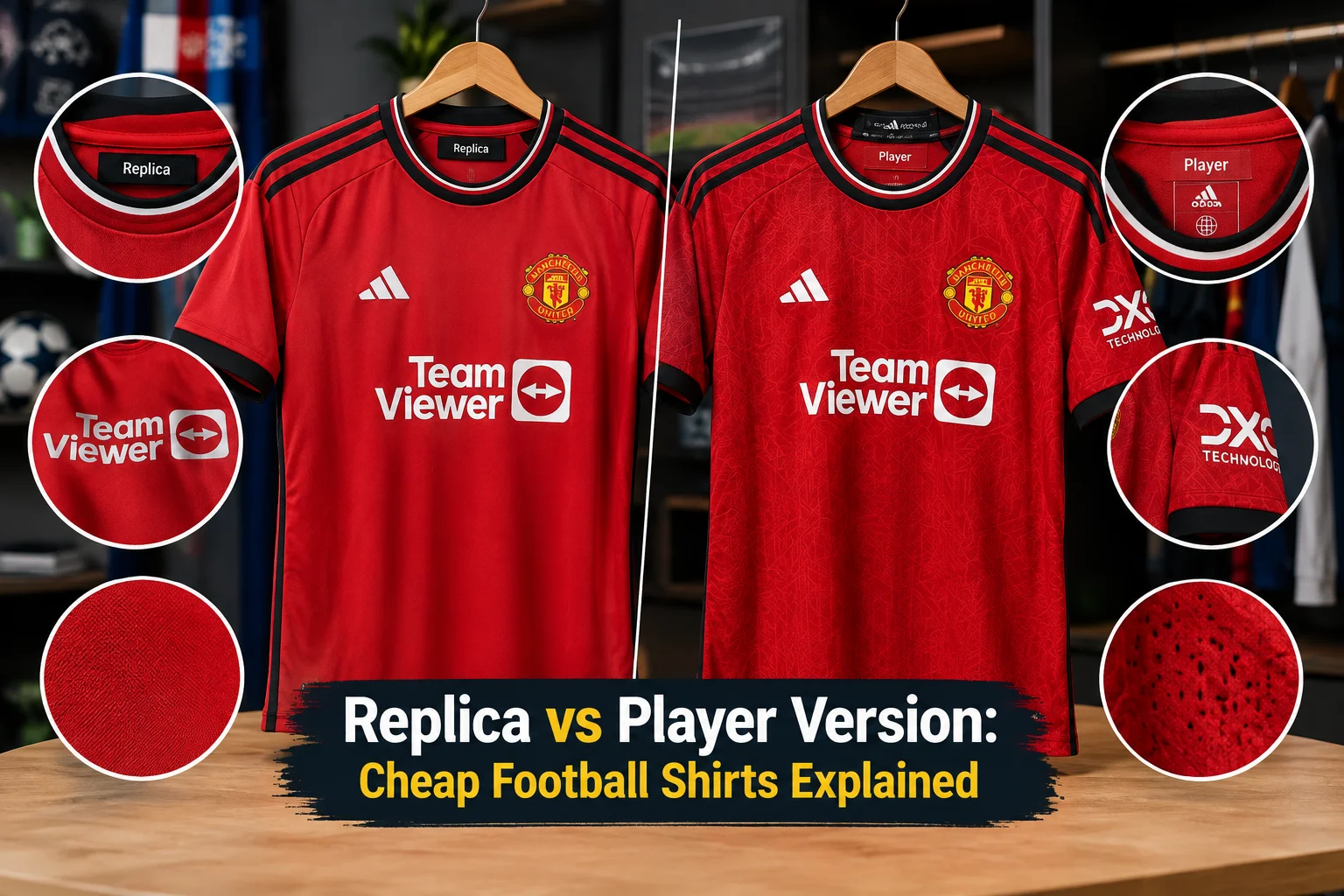
Walk into a club shop and the same shirt is on the rail twice, at two prices. One is labelled “authentic” or “match” or “player version” and costs £110 to £125. The other is “replica”, “stadium” or “fan version” and costs £80 to £90. Walk out of the shop and open a browser and the same design is available for £20 to £30 from a dozen independent retailers, labelled as a replica of the replica. Most supporters have no idea what separates the three, and the manufacturers are not in a hurry to explain. This is the guide to the tiers, why they exist, and how to judge cheap football shirts against the expensive ones.
The player version
The authentic shirt is, in theory, what the players wear. It uses the manufacturer’s top fabric, Nike’s Aero-FIT or Dri-FIT ADV, adidas’s Climacool+ on a jacquard knit, Puma’s ULTRAWEAVE, and it is cut slim and short, with stretch panels under the arms and a body that finishes above the hip. The crest, sponsor and any competition patches are heat-bonded rather than stitched, to save weight and keep the fabric flexible. It weighs noticeably less than the replica, dries faster and fits like a base layer. It is also less durable: the fabric is thin, the bonded transfers can lift after repeated washing, and the fit does not forgive a winter coat.
The replica
The stadium or fan version uses a heavier interlock polyester knit with standard moisture management, a looser cut with a longer body, and an embroidered or woven crest. It is designed for wearing over a T-shirt, sitting in and washing forty times a season, and it does all of those things better than the player shirt. The colours and the design are identical; the manufacturer’s logo is the same; the sponsor is the same. From ten yards away nobody can tell the two apart, and from the stands nobody can tell them apart at all.
Why the price gap is bigger than the cost gap
The player shirt costs more to produce, but not twice as much. The gap is mostly positioning: the manufacturer sells the authentic version to the supporter who wants what the players wear and will pay for it, and the replica to everybody else. At Nike’s US pricing for the 2026/27 Chelsea home kit, the authentic shirt retails at $175 and the replica at $100, a ratio that holds across most clubs and most brands. The premium buys a fabric, a fit and a label, and for anyone not playing in the shirt the first two are of limited use.
The cheap shirt
Below both official tiers sits the independent market: fan-version shirts sold online, usually shipped from Asia, at a quarter of the club-shop replica price. These vary enormously. The best are made on the same kind of interlock polyester as the official replica, with a sublimated or well-applied crest, accurate colours and a fit close to the official fan version. The worst use thin, shiny fabric, a fuzzy printed crest and sizing that bears no relation to the chart. Some are licensed, most are not, and the buyer has to judge for themselves.
How to judge a cheap shirt
Five checks separate the good from the bad. First, the fabric: look for a description of the knit or a weight in grams per square metre, and be wary of anything described only as “polyester”. Second, the crest: zoom in on the product photos and compare the edge quality with the official replica; a clean embroidered or woven crest is a good sign, a soft-edged print is not. Third, the photos themselves: a retailer showing their own product, front and back, on a table rather than a stock image is one you can trust more. Fourth, the size chart, in centimetres, with a half-chest measurement. Fifth, the returns policy and the payment method: a card or PayPal with buyer protection, never a bank transfer.
What you lose, honestly
A £25 shirt will not have the latest cooling fabric, the exact current-season sponsor placement or, in most cases, an official licence. It may have small inaccuracies in the crest or the trim that a collector would notice and a supporter would not. The colours are sometimes slightly off in one direction or the other. It will last a season of normal wear if it is washed cold and not tumble-dried, which is the same instruction the official shirt comes with.
What you do not lose
The colour, the design, the crest and the feeling of wearing it. Nobody at the match is inspecting the weave. A well-chosen cheap shirt in the right colours does exactly what a football shirt is for, which is to show which side you are on, and it does it for the price of a pint and a programme at some grounds.
Who should buy which
Buy the player version if you play in it, if you collect, or if you want the fabric for its own sake and can afford it. Buy the official replica if you want the licence, the embroidery and the certainty, and are happy to pay £80 to £90 for them. Buy a cheap fan version if you want to wear the colours every week without thinking about it, and do the five checks before you order. All three are legitimate choices, and the supporter in the £25 shirt is no less a supporter than the one in the £120 one.
Sizing between the tiers
The single most common complaint about the authentic shirt is that it does not fit. It is cut for an athlete, runs a full size smaller than the replica in most brands and finishes higher on the hip. A supporter who wears a large replica will usually need an extra-large authentic, and even then it will sit closer to the body than they expect. Cheap fan-version shirts are less predictable in either direction, which is why the size chart in centimetres matters more for them than for either official tier.
Women’s and youth cuts
All three tiers are now sold in women’s and youth cuts at most clubs, and the differences carry across: the women’s authentic is slimmer still, the women’s replica is a tailored version of the unisex shirt, and youth shirts are sized by age with a height range that is the more reliable guide. Junior replicas have risen in price faster than adult shirts this year, which is one reason the independent market for children’s shirts has grown so quickly.
The two-tier future
The manufacturers know the independent market exists and have responded by pushing the authentic tier further upmarket rather than by lowering the replica price, which suggests they have accepted that the £80 to £90 replica is now the middle of the market rather than the bottom. For the supporter, that means the choice is wider than it has ever been and the information is thinner. Know what the labels mean, check the five things, and buy the shirt that suits the way you will wear it. For more on kits, players and the game, explore AQ Football.