
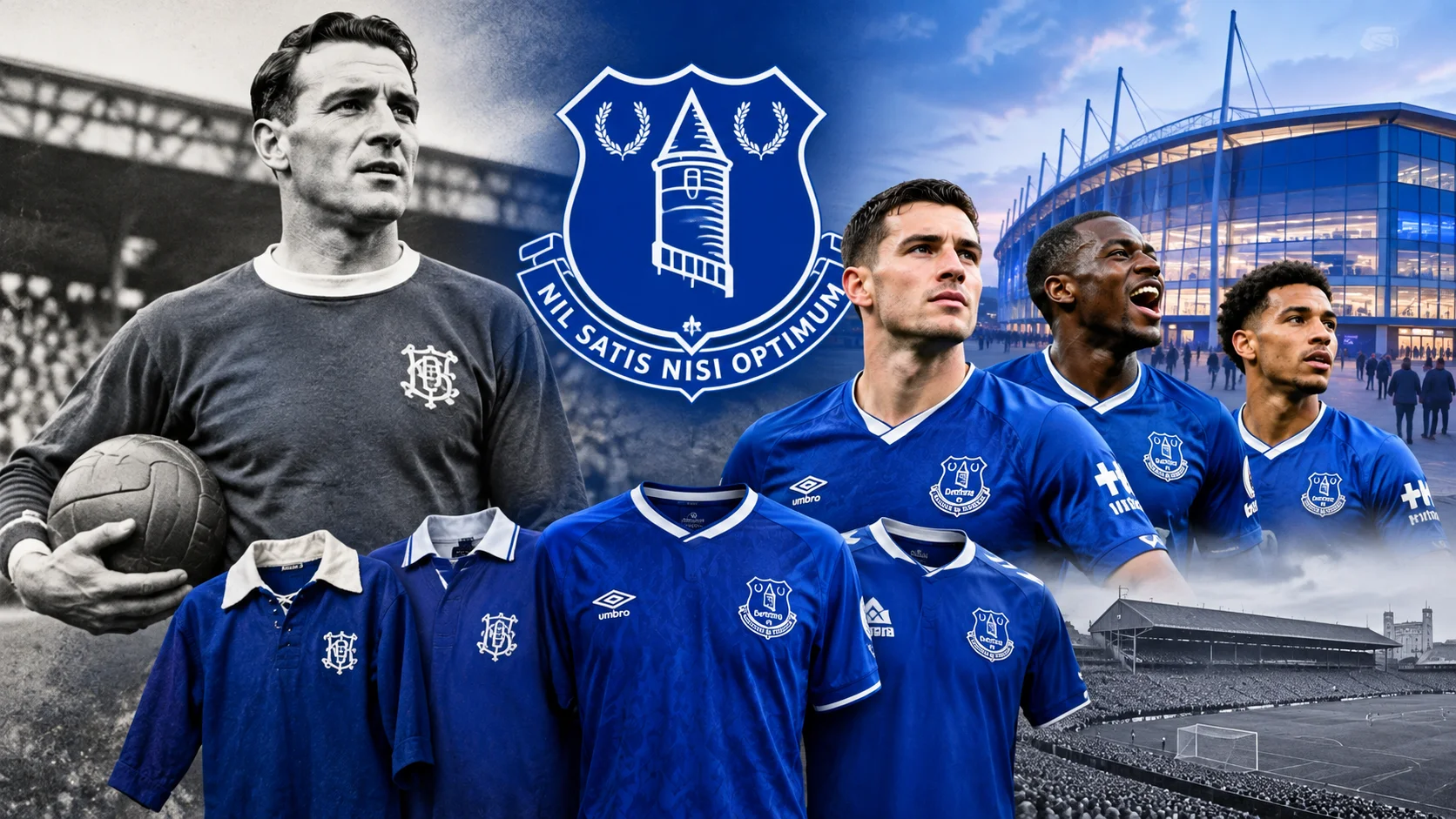
Everton’s jersey has been royal blue since 1901, but the men who wore it are what give it meaning, and the club’s history can be read off their backs. A 9 that scored sixty goals in a season. A 1 in a Wales shirt who is still the best goalkeeper the club has had. An 18 worn by a sixteen-year-old who announced himself against Arsenal. A 10 that carried the team into a new home. This is a tour through the Everton jersey by the players who defined it, from Goodison Park’s first great forward to the first season at the Hill Dickinson Stadium.
Dean: the 9 that set the record
William Ralph “Dixie” Dean scored 60 league goals in the 1927/28 season, a record for the English top flight that has stood for nearly a century and will not be broken. He wore the 9, though not on his shirt: numbers arrived at Everton in the 1933 FA Cup final against Manchester City, the first final in which players were numbered, and Dean wore 9 as Everton, numbered 1 to 11, beat City, numbered 12 to 22, 3-0. He scored 383 goals for the club in a plain royal blue jersey with a lace-up collar. His statue stands outside the old ground, and the Everton 9 has been measured against him ever since.
Young, Ball and the Holy Trinity
Alex Young, the “Golden Vision”, wore the 9 in the 1963 title side and was adored in a way that outlasted his goals. The 1970 champions were built around a midfield of Howard Kendall, Alan Ball and Colin Harvey, and Ball’s number 8, worn with the swagger of a World Cup winner, was the first Everton jersey that sold to children as a piece of identity rather than a piece of kit. Bob Latchford wore the 9 through the late 1970s and scored 30 league goals in 1977/78 to win a newspaper’s prize, the last Everton player to reach that figure.
Southall, Sharp and the 1980s
The 1980s jersey belongs to a Welshman. Neville Southall wore the 1 from 1981 to 1998, made 751 appearances, a club record, and was the best goalkeeper in the world for a period around the 1985 title and Cup Winners’ Cup. In front of him Graeme Sharp scored 159 goals, Andy Gray led the line in 1985, Kevin Sheedy wore the 11 and delivered the free-kicks, and Peter Reid ran the midfield. The Le Coq Sportif and Umbro jerseys of that decade, with the Hafnia and NEC sponsors, are the ones most often reissued.
Rooney: the 18
Wayne Rooney wore 18 because it was what he was given, and on 19 October 2002, five days before his seventeenth birthday, he scored a curling shot against Arsenal that ended a 30-match unbeaten run and announced the best English player of his generation. He wore the number for two seasons before his sale to Manchester United, and returned in 2017 to wear the 10 for a single year. The 18 has been worn by others since, including Jack Grealish on loan in 2025/26, but it is Rooney’s.
Cahill, Lukaku and the Moyes years
Tim Cahill’s 17 was the jersey of the first David Moyes era, a midfielder who scored headers from nowhere and celebrated by boxing the corner flag. Romelu Lukaku wore the 10 and scored 87 goals in four seasons, the most by an Everton player in the Premier League. Jordan Pickford has worn the 1 since 2017, the longest-serving player in the current squad and England’s goalkeeper at the 2026 World Cup, where his country finished third.
The jersey that moved
Iliman Ndiaye wore the 10 through the final season at Goodison Park and the first at the new stadium, scoring in the last men’s match at the old ground and in the first competitive match at the new one. Everton’s move to the Hill Dickinson Stadium at Bramley-Moore Dock was confirmed in the spring of 2025, when the club announced a long-term naming rights partnership with the Liverpool law firm and confirmed the final Goodison match would be against Southampton on 18 May 2025. Castore’s jersey for the first season carried a wave pattern inspired by the Mersey, and Moyes, back for a second spell, guided the team to 13th.
2026/27
The second season at the new ground opened at home to Crystal Palace, in a royal blue Castore jersey that keeps the traditional white trim, with an away kit in blue and yellow stripes that reviewers have rated highly. The adult replica is £80. The names on the back are mostly new, as they have been for a decade, but the numbers are the same ones Dean, Southall and Rooney wore, and the supporters who buy them know the lineage.
The 1966 final and Trebilcock
The royal blue’s most dramatic Wembley afternoon belonged to a player almost nobody expected to be there. Mike Trebilcock, a Cornishman signed from Plymouth that winter, was picked ahead of Fred Pickering for the 1966 FA Cup final against Sheffield Wednesday, and with Everton 2-0 down scored twice in five minutes before Derek Temple’s winner completed the comeback. He wore the 8 that day and played only fourteen times for the club in total. The blue shirt of that final, plain with a white crew neck, is among the club’s most reissued designs.
Calvert-Lewin and the modern 9
Dominic Calvert-Lewin wore the 9 for eight seasons, scored 16 Premier League goals in 2020/21 under Carlo Ancelotti and played for England at Euro 2020, and his injuries in the seasons after were a large part of why Everton spent three years near the bottom of the table. He left on a free transfer in 2025, and the number has passed on. The 9 at Everton remains the shirt supporters most want to see filled properly, and the one the club has found hardest to fill.
Everton Women at Goodison
Goodison Park’s second life began in the summer of 2025, when Everton Women moved in from Walton Hall Park. The women’s team wear the same royal blue jersey with the same crest, play their Women’s Super League matches at the old ground, and have given the stadium a future that a demolition would not. For families who grew up at Goodison, it means the ground can still be visited, and the jersey can still be seen there.
What a jersey number carries at Everton
Everton have not won a trophy since 1995, which is the longest wait among the traditional big clubs, and in that time the jersey has carried more history than success. That is not a weakness. The 9 still means Dean and Sharp, the 1 still means Southall, the 18 still means Rooney, and a club that can sell a number on the strength of what happened in it decades ago has something most clubs cannot buy. The new stadium is a chance to add names to the list. For more Premier League history and kit stories, explore AQ Football.