
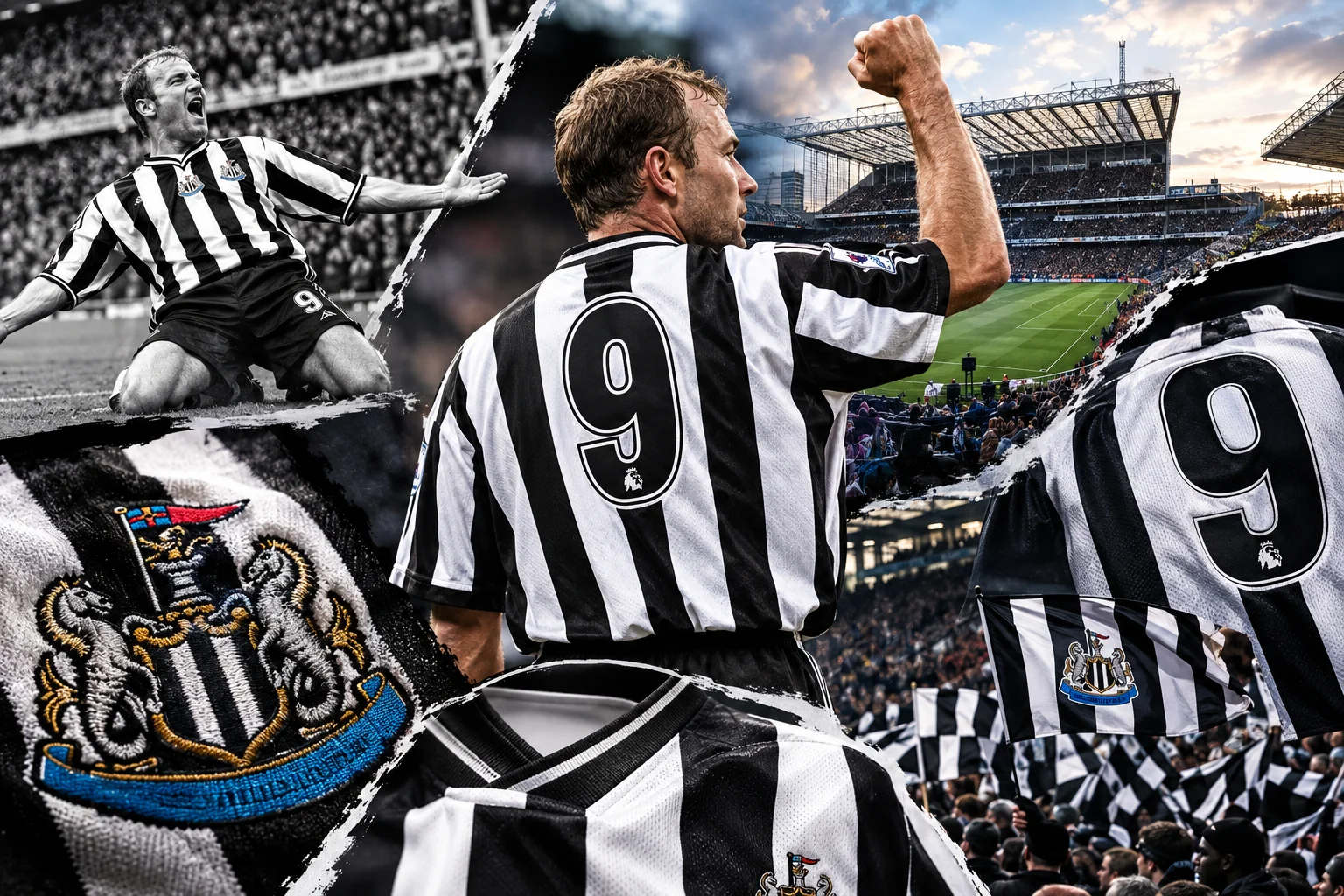
At most clubs the number 9 is a shirt number. At Newcastle United it is an office. The men who have held it, Gallacher, Milburn, Macdonald, Cole, Ferdinand, Shearer, are the club’s history told in one digit, and the supporters judge every new centre-forward against a standard set by a man who scored 206 goals in the shirt and has a statue outside the ground. This is the story of the Newcastle United jersey through its most important number, and of the 2026/27 design that has divided the people who wear it.
Gallacher and Milburn
Hughie Gallacher, a five-foot-five Scot, captained Newcastle to the 1927 league title and scored 143 goals in five seasons, and he is the first name in the lineage. Jackie Milburn, from Ashington, held the shirt from 1943 to 1957, scored 200 goals, and won the FA Cup three times in five years, scoring in the 1951 and 1955 finals. “Wor Jackie” is the man the statue outside St James’ Park depicts, and the standard against which Shearer was measured. Both wore the broad black and white stripes of their eras with a plain collar and no sponsor.
Macdonald: Supermac
Malcolm Macdonald arrived from Luton in 1971, scored a hat-trick on his home debut against Liverpool and went on to score 121 goals in five seasons, including the goals that took Newcastle to the 1974 FA Cup final. He was quick, loud and adored, and the Umbro shirts of the mid-1970s, with their wide collars and thin stripes, are associated with him more than with any other player. His sale to Arsenal in 1976 was the first of several departures of a number 9 that the club never fully explained.
Cole, Ferdinand and the Entertainers
Andy Cole scored 41 goals in the 1993/94 season, the club’s first back in the top flight, then was sold to Manchester United in January 1995 for a record fee, to widespread disbelief. Les Ferdinand took the shirt, scored 29 in his first season and helped Kevin Keegan’s side finish second in 1996. Both wore the adidas shirts with the Newcastle Brown Ale logo that are now the most collected Newcastle designs. Ferdinand then gave the number up, at Keegan’s request, to the man who had just signed for a world record fee.
Shearer: 206
Alan Shearer arrived from Blackburn in July 1996 for £15 million, a world record, chose Newcastle over Manchester United, and wore the 9 for ten seasons. He scored 206 goals for the club, passing Milburn’s record in February 2006, and retired at the end of that season having never won a trophy in the shirt. He remains the Premier League’s all-time leading scorer, his statue stands outside the Gallowgate End, and the phrase “Shearer’s 9” is used at the club as a job description. Every centre-forward signed since has been asked, in his first press conference, about the shirt.
The custodians since
Obafemi Martins, Papiss Cissé, Callum Wilson and others have held the number since 2006 with varying success, and the club’s most expensive forward of recent years, Alexander Isak, wore 14 rather than 9 throughout his time at the club. Isak scored the goal that helped win the 2025 League Cup final against Liverpool, the club’s first domestic trophy since Milburn’s era, and was sold to Liverpool that summer. The 9 remains, in the club’s own mythology, a shirt to be earned rather than assigned.
The 2026/27 jersey
The shirt the current forwards wear is the most argued-about in the club’s modern history. adidas’s home design uses a “disrupted stripe” pattern, the black and white bands broken and offset rather than continuous, with a colour accent at the crew neck and a magpie on the back of the neck. It was launched in June without a front-of-shirt sponsor, the three-year deal with Sela having ended. Knox Hydrate, which had already taken the naming rights to the training ground, was announced as the new front-of-shirt partner later that month on a three-year deal, and supporters who had bought the unbranded shirt were offered the logo free of charge. The adult replica costs £85.
The argument
One national ranking placed the shirt last of the twenty in the league and called it a barcode. Others have defended it as a necessary break from a template unchanged for a century. What both sides agree on is that the shirt is recognisable, because even broken stripes read as Newcastle, and that it will be judged by results rather than by design. The number on the back, meanwhile, carries the same weight it has since 1927, and whoever wears it this season will be measured against a statue.
The other numbers
The 9 dominates, but the shirt has other lineages. Kevin Keegan wore the 7 as a player from 1982 to 1984 and took the club up in it; Peter Beardsley wore the 8 in two spells; David Ginola’s 14 was the shirt of 1995/96; Shay Given’s 1 lasted twelve seasons. In the current squad Bruno Guimarães has made the 39 his own since 2022, Dan Burn’s 33 is the shirt of a Blyth-born supporter who scored at Wembley, and Anthony Gordon wears the 10. Each has a following. None carries the weight of the 9.
The 2025 final
The trophy that changed the club’s modern story was won on 16 March 2025 at Wembley. Dan Burn, six foot seven and a local, headed the first goal from a corner shortly before half-time; Isak scored the second early in the second half; Federico Chiesa’s late goal for Liverpool made the last minutes uncomfortable. Newcastle won 2-1 to lift the League Cup, the first domestic trophy since the 1955 FA Cup and the first of any kind since the 1969 Fairs Cup. The adidas shirt of that season, black and white stripes with the Sela logo, sold out within days of the final and remains the most-worn design at St James’ Park.
Why the 9 matters more here
Every club has a famous number. What makes Newcastle’s different is that the number is attached to a type of player and a type of relationship rather than to any one man: the local centre-forward, or the adopted one, who scores in front of the Gallowgate and is loved for it. Milburn was a miner’s son from up the road. Shearer was a Gosforth boy who turned down Manchester United to come home. The shirt is a promise between the club and its supporters, and the jersey it sits on, however the stripes are drawn, is only the background. For more player analysis, kits and Premier League history, explore AQ Football.