
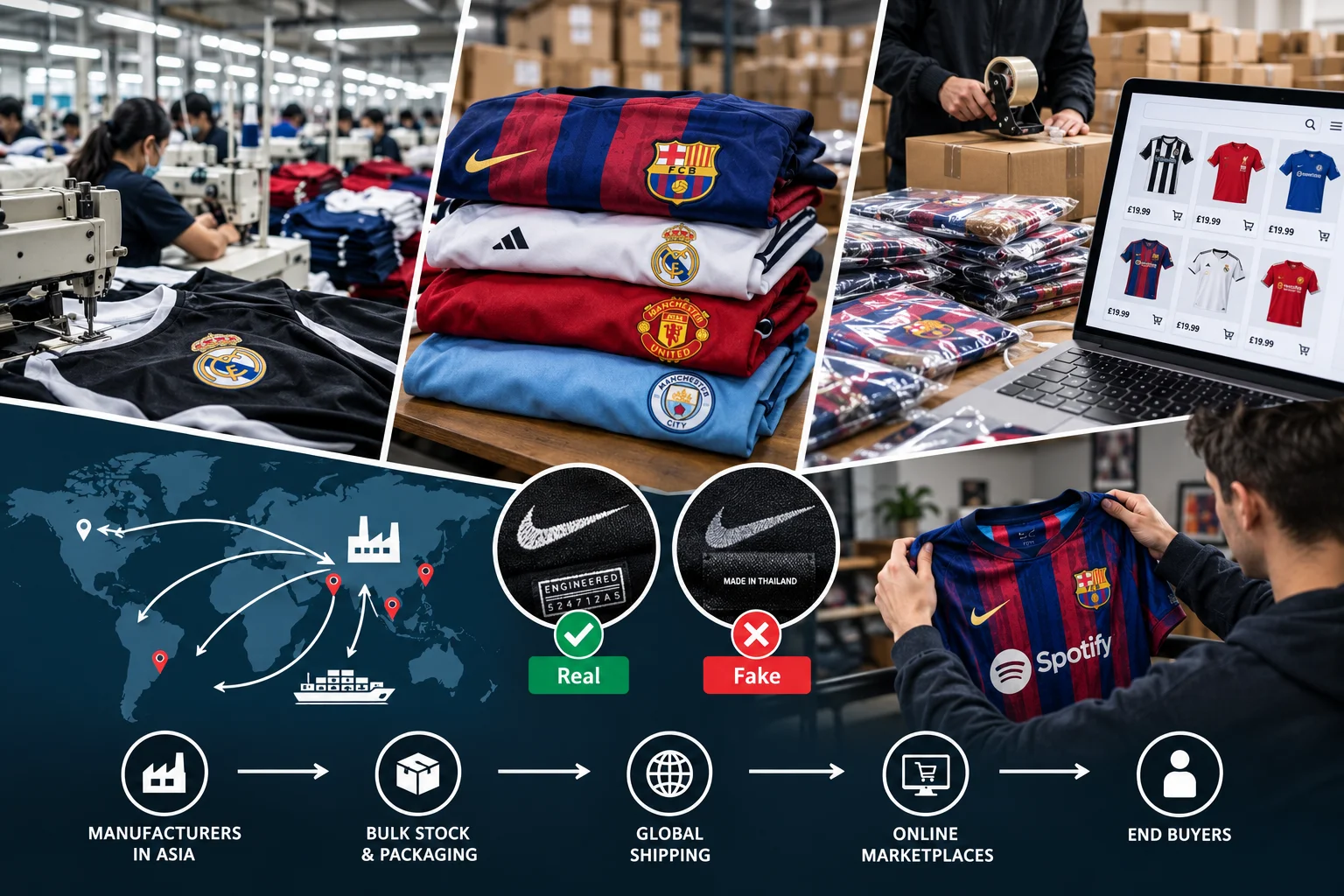
A replica shirt is one of the few products most supporters buy from their club, and almost nobody knows how the business behind it works. Who sets the price, who makes the money, why kits launch when they do and why some sell out in a week while others sit in a sale for a year are all answerable questions, and the answers are useful if you are buying.
The short version is that the club does not make the shirt, usually does not set the price, and takes a smaller share of the proceeds than most people assume.
Who actually makes the money from a replica shirt?
A kit deal is a licensing arrangement. The supplier designs and manufactures the kit, pays the club an annual fee for the right to do so, and keeps the revenue from wholesale sales. The club gets the fee, plus a margin on anything it sells through its own shop and website, plus the value of the sponsor exposure.
That is why a club selling a huge number of shirts does not necessarily earn proportionally more. For most clubs the licensing fee is the dominant number and it is agreed in advance, so volume mainly benefits the supplier. The exceptions are clubs that have taken manufacturing in house or negotiated a revenue share, which a handful have done precisely to capture that upside.
The consequence for buyers is that the price you pay is generally set by the supplier’s recommended retail price rather than by the club, and it is broadly consistent across retailers while a kit is current. Our piece on how football kit supplier deals work goes into the structure of these agreements in more detail.
The release cycle
Most clubs follow the same pattern. The home shirt launches first, usually in the weeks before the season starts, and is designed to carry the season. The away shirt follows soon after, and the third shirt arrives a month or two into the campaign, often timed to a European competition.
This staggering is deliberate. It gives the supplier three separate retail moments instead of one, and it means a supporter who has already bought the home shirt in July has a reason to buy again in October. It also explains why third kits are usually the most adventurous designs: they are sold to people who already own the other two and are looking for something different.
Kits now typically run for one season rather than two, which was the older pattern. That doubles the number of launches and is one of the main reasons the annual cost of following a club has risen.
When is the best time to buy?
If you want the current home shirt, there is no good time — it holds its price until it is replaced. The best you can do is wait a month or two into the season for the initial launch pricing to settle and for occasional promotions.
If you are flexible, the pattern is reliable. Away and third shirts start getting discounted around the turn of the year. Everything drops sharply once the following season’s kit is announced, which is usually in the late spring, and the deepest discounts come in the weeks immediately after the new home shirt goes on sale. A shirt bought at that point is a season old and costs a fraction of what it did.
Sizes are the catch. The discounting is heaviest on the sizes that sold least, which generally means very small and very large, so popular sizes disappear from the sale early.
Licensing, patches and why shirts differ
A match shirt and a retail replica are not the same product, and the differences are partly licensing. Competition sleeve patches are licensed separately and are not included on a retail shirt by default — they are usually sold as an optional add-on and applied at the point of sale.
Official name and number printing works the same way. The lettering is produced to a league specification by a licensed supplier, which is why it costs what it does and why you cannot get it done properly anywhere else. It is also why a shirt sold with printing already applied is worth checking carefully, since unofficial printing is the single most common corner cut.
Kids’ kits and the rest of the range
The children’s range runs on the same cycle but with different economics. Kids’ shirts are produced at the entry level only, carry a lower retail price, and are discounted on the same schedule as the adult range — which means a child’s shirt bought in June, a season old, costs very little.
The complication is sizing. Children’s kit is sold by age, and age labels vary significantly between suppliers and between seasons, so a sale shirt in the wrong size is a false economy. Buy on the chest measurement where it is published, and size up rather than down if you are guessing.
Training wear is the other part of the range worth knowing about. It carries no competition patches and no sponsor arrangement, which makes it cheaper than match kit while using similar fabrics, and it is rarely counterfeited because the margins do not justify it.
Why some kits sell out and others do not
Supply is planned months ahead on forecast demand, and the forecast is frequently wrong. A design that leaks early and is received badly will be produced in the same quantity as one that is received well, because the order was placed long before anyone reacted to it.
That creates the two situations supporters see. A popular design sells out in the first weeks and is never restocked, because the production run for that season is finished. An unpopular one sits in a sale for eighteen months. Neither says much about quality — it is the gap between a forecast made in winter and a reaction in summer.
The practical lesson is that if you want a specific kit in a specific size, buy it early, and if you do not mind which season you are wearing, buy late. Looking after it afterwards is a separate skill, and how to wash and store football shirts covers that.
Frequently asked questions
Why do football shirts cost so much?
The price is set by the supplier’s recommended retail price and reflects licensing fees paid to the club, technical fabrics, and the fact that a kit now lasts one season rather than two. The club’s own share is smaller than most supporters assume.
When do replica shirts go on sale?
Away and third kits start being discounted around January. The steepest cuts come when the following season’s kit is announced in the spring, and the weeks just after a new home shirt launches are the cheapest point of all.
Are sleeve patches included?
Usually not on a retail shirt. Competition patches are licensed separately and are normally an optional extra applied when you buy.
Do clubs make most of their money from shirt sales?
No. For most clubs the supplier’s licensing fee is the main kit-related income, and it is fixed in advance, so selling more shirts mainly benefits the manufacturer.