
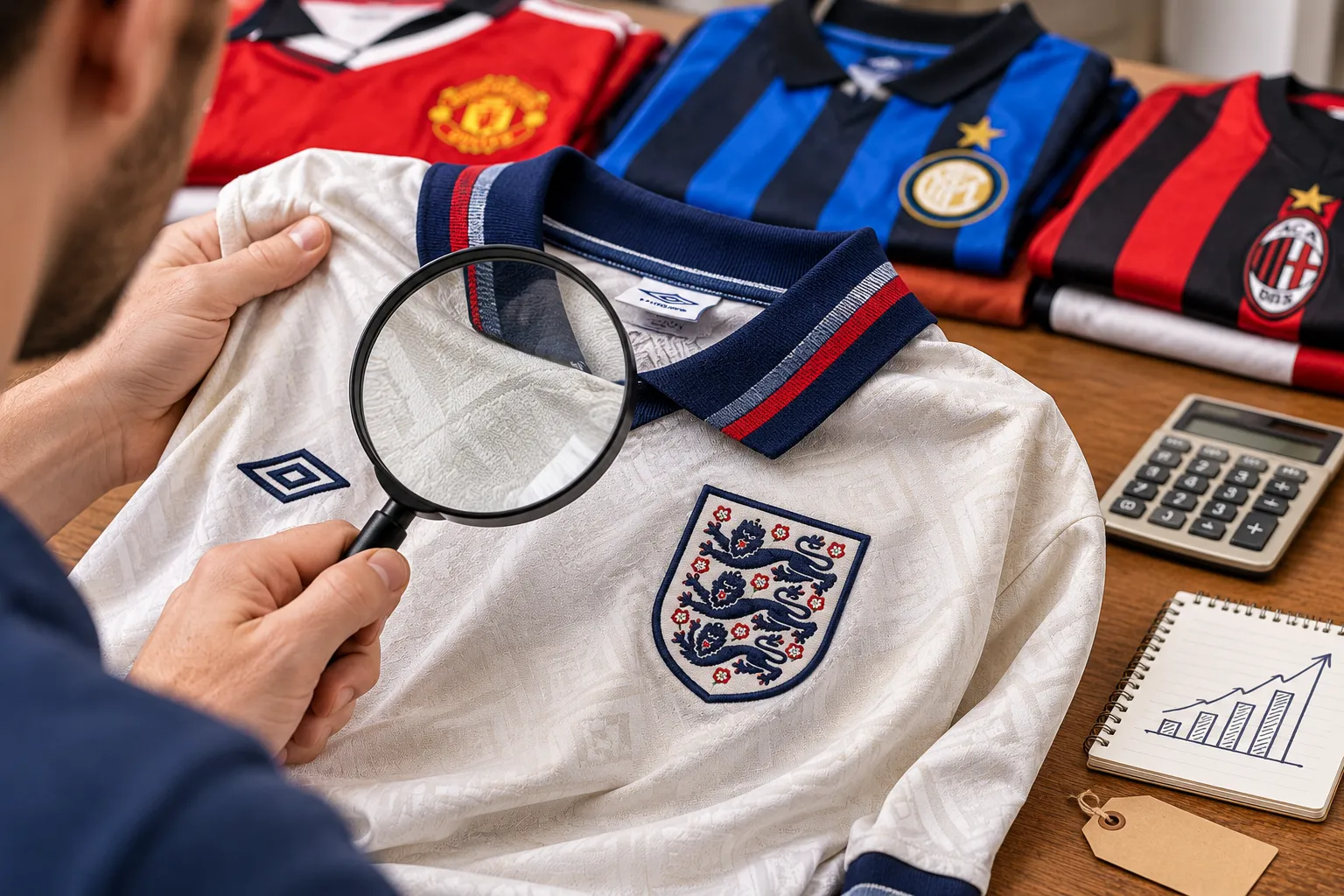
Working out how to value an old football shirt is less mysterious than it looks, because the market is reasonably efficient and the drivers are few. Five things set the price, and once you can assess each of them you can put a realistic range on almost anything.
What you cannot do is value a shirt by what it meant to you, which is the mistake almost everyone makes with something they found in a loft.
The five things that set the price
Who wore it, if anyone. A shirt associated with a specific player is worth more to collectors of that player and less to everybody else. A plain shirt has a wider market and a lower ceiling.
What it is attached to. A season in which something happened is worth multiples of an adjacent season in which nothing did, regardless of which shirt is the better design. This is the single largest driver.
Scarcity. How many were made and how many survive. Pre-replica-boom shirts are genuinely rare because few were sold; nineties shirts were produced in enormous numbers and are not rare at all, however old they feel.
Provenance. For anything claimed as match worn or player issued, the chain of custody is most of the value. Without it you are selling a used shirt.
Condition, which matters less than people expect and we come to below.
How to find comparables
The only reliable way to value anything is to find what similar items actually sold for, which is different from what they were listed at. Completed sales on the large auction platforms are the most accessible source, and the filter that matters is “sold” rather than “available”.
Specialist auction houses publish results for the higher end, and those archives are genuinely useful for anything significant. Collector forums and dedicated shirt communities are better still for mid-market items, because the people there know the difference between two similar shirts in a way a general marketplace does not.
Build a range from several comparables rather than anchoring on one. A single high sale is as likely to be an outlier as a benchmark, and the most common error in home valuation is finding the best price ever achieved and treating it as the going rate.
Why does condition matter less than people think?
Because for genuinely scarce items, rarity dominates. A shirt from 1970 with a repaired tear and faded printing is worth considerably more than a mint shirt from 1996, because there are very few of the first and a great many of the second.
Condition becomes decisive when supply is plentiful. Among nineties shirts, where thousands survive, a mint example with its original tags commands a real premium over a worn one, because the buyer has a choice.
There is also a category where wear adds value rather than subtracting it: anything match worn. Evidence of use is part of the authentication, so a pristine shirt claimed as worn in a significant match is both less convincing and less valuable than a scuffed one with the right pattern of damage, as how to check a football shirt is match worn sets out.
What reduces the value of a shirt?
Printing applied after the fact is the big one. A shirt that has had a name and number added unofficially, or official printing applied years later, is worth less than the same shirt plain because collectors want either the original configuration or a blank canvas.
Alterations of any kind. A shirt taken in at the sides, a collar replaced, a sleeve shortened: all legitimate things people did to clothes, all reductions in value.
Washing damage, which is the quiet one. Cracked printing, a bobbled surface and uneven fading all come from hot washes and tumble drying, and they are irreversible. If you own anything you might one day sell, the care advice in how to wash and store football shirts is worth following now rather than later.
And missing labels. A shirt with the neck labels cut out frequently done because they itched loses both value and a major authentication point.
Reproductions have a value too, just a different one
A licensed reproduction is worth roughly what a current replica is worth, falling with age and condition like any garment. It does not appreciate, and it will not become valuable because it is old, because it was never scarce.
That is not a criticism. A reproduction is bought to wear, and judged as a shirt it is frequently better made than the original it copies. The mistake is buying one as an investment, which happens often enough that it is worth stating plainly: the reproduction market has no appreciation curve.
Unlicensed tribute shirts sit lower still on resale, because they carry no badge and the buyer pool is smaller. Again, fine to own, not an asset.
How the market moves
Prices are not static and they move for reasons worth anticipating. A player’s retirement tends to lift their shirts modestly; a death lifts them sharply and the effect persists. A club anniversary, a stadium move or a documentary can all produce a spike in a specific era.
Broader trends matter more. Interest in a particular decade rises and falls, and the nineties have been the dominant collecting era for some time which means prices there are high relative to scarcity, and the seventies and eighties arguably offer better value for anyone buying to hold rather than to wear.
The practical implication for a seller is timing. If you own something tied to a specific player or season, there will be moments when the market is paying more for it, and they are usually foreseeable a few months out.
Selling it yourself, or through someone
A specialist auction takes a commission from both sides and in exchange gives you an informed description, a catalogue and a bidder list that already collects this material. For anything genuinely scarce that is usually worth the fee, because the right buyer is more likely to see it.
Selling privately on a general marketplace saves the commission and costs you the audience. It works for mid-market reproductions and ordinary originals, where the buyers are everywhere and the item needs no expertise to describe. It works badly for anything that needs authenticating, because a general buyer discounts heavily for uncertainty.
The middle route is a collector community or a dedicated shirt forum, where the audience is knowledgeable, the fees are nil and the price achieved sits between the two. The catch is that knowledgeable buyers pay the correct price rather than an optimistic one, which is only a catch if you were hoping for the latter.
Getting a formal valuation
Worth doing above a certain level, and the threshold is lower than people assume anything you believe might be worth four figures is worth a professional opinion before you sell it.
Specialist auction houses with a sports memorabilia department will give an opinion, usually free, because they want the consignment. That is a conflict of interest and also the most informed view you will get cheaply. Get two if the item is significant.
Be clear which number you are asking for. An insurance valuation is a replacement cost and is typically higher than what the item would realise at auction after fees. People who confuse the two end up disappointed at the sale. For the reproduction end of the market, our guide to Italy retro shirts covers what to check before buying rather than selling.
Frequently asked questions
What makes an old football shirt valuable?
Mainly what it is attached to and how scarce it is. The player, the provenance and the condition follow, with condition mattering least on genuinely rare items.
Where do I find what a shirt is actually worth?
Completed sales rather than active listings sold results on the large marketplaces, plus specialist auction archives for anything significant. Build a range from several, not one.
Does printing add value?
Original, period-correct printing can. Printing added later, officially or otherwise, reduces value compared to the same shirt plain.
Are reproductions worth anything on resale?
Roughly what a used replica is worth, declining with age. They were never scarce, so they do not appreciate buy them to wear rather than to hold.