
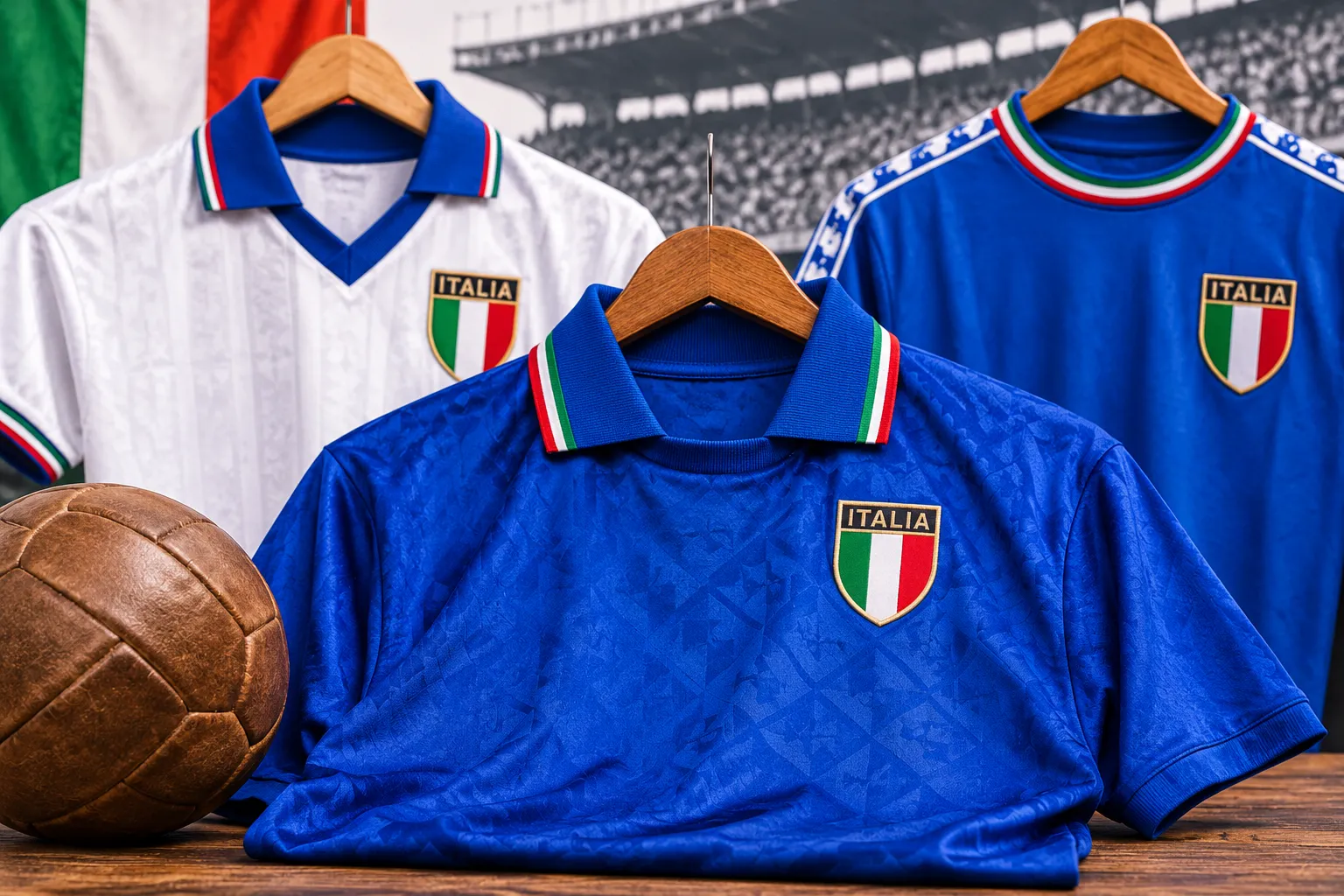
italy retro shirts sit in an awkward place in the market: enormously desirable, widely reproduced, and copied badly more often than almost anything else. Nineties Italian football is the most collected era in the hobby outside England, which means demand far exceeds the supply of genuine originals, and that gap is filled by reproductions of wildly varying quality.
The good news is that Italian shirts of that period have unusually specific details, which makes a poor copy easy to identify once you know what you are looking at.
The blue is the first thing to check
Italy’s blue has a name and a history. It is Savoy blue, taken from the House of Savoy, the royal house that unified Italy which is why a republic plays in a monarchy’s colour, and why the shade matters to people who care about these things.
That shade has shifted across eras, and the shifts are documented. Shirts from the seventies and eighties run darker; the nineties brought a brighter, more saturated blue; more recent kits have moved again. A reproduction in a generic royal blue is the single most common error, and it is visible immediately next to a photograph of the real thing.
Judge it in daylight rather than under shop lighting, and judge it against an image of the specific season rather than against your memory. The difference between two eras of azzurro is subtle in isolation and obvious side by side.
The crest, and what it should say
Italy’s shirt badge has changed form several times, and each version sits in a clear window. The modern crest carries the federation’s initials and, since 2006, a star above it for each World Cup won four of them, following the win in Germany.
That star count is the fastest dating tool available on an Italy shirt. Four stars means 2006 or later. Three means between 1982 and 2006. Any reproduction claiming to be a 1982 shirt with four stars above the badge has been made by somebody who did not check, and that tells you everything about the rest of it.
Embroidery quality is the second check. Hold it at arm’s length: the lettering and the shield should read cleanly, and on a poor copy the stitching is dense enough that the detail collapses into a blur.
Why does the Kappa cut matter so much?
Because for a stretch of the nineties Italy’s shirts were made deliberately skin-tight, and that cut is the defining feature of the era. Kappa’s approach was a genuinely tight, stretchy garment designed to be hard to grab a long way from the baggy fits everyone else was producing at the time.
A reproduction of one of those shirts that fits loosely has missed the entire point. It is also the easiest corner to cut, because an accurate tight pattern in a stretch fabric costs considerably more to produce than a standard blank.
The practical consequence for a buyer is sizing. A faithful reproduction of a mid-nineties Italy shirt will feel at least a size smaller than you expect, and that is correct. Size up if you want to wear it rather than display it, and check the seller’s measurements rather than the label the method we set out in how to spot a fake football shirt.
The Serie A club shirts, which are the bigger market
Italy’s national team is only part of it. Nineties Serie A produced the most reproduced club shirts in world football, because the league was the strongest on the continent and the designs were extraordinary sponsor typography, bold patterning and colour combinations nobody else was attempting.
That demand has consequences. The club shirts of that era are copied at every quality level from excellent to insulting, and because many of the original suppliers no longer hold the licences, the market is full of unlicensed tribute versions alongside the official reproductions.
Both are legitimate products if sold honestly. What is not legitimate is a tribute shirt with a crest added, which crosses from homage into counterfeiting regardless of how the listing describes it. The Intellectual Property Office publishes the UK position on counterfeit goods.
The construction tells
Four, in the order worth running them. Stretch any patterned area: if colour thins and a pale base shows through, the pattern was printed onto a blank rather than knitted in.
Check the sponsor reproduction. Italian shirts of the period carried sponsor typography that was specific and frequently unusual, and copies get the letterforms approximately right and the proportions wrong. Compare against an image rather than trusting your eye.
Turn it inside out. A genuine shirt or a good reproduction has a neatly finished neck tape, clean overlocked seams and labels sewn in squarely; a cheap copy puckers at the hem and carries labels that do not belong to the same season as each other.
And handle the fabric. Period Italian shirts used specific materials with a distinctive feel, and a thin modern polyester with an old design printed on it announces itself the moment you pick it up.
Why Italian shirts are copied more than most
Supply and nostalgia, in that order. Serie A in the late eighties and nineties held most of the best players in the world, and the shirts of that period were designed with a boldness nobody else matched which means demand today is enormous and the stock of genuine originals is fixed and shrinking.
The licensing position compounds it. Many of the original suppliers no longer hold the rights to those clubs, and some of the clubs have changed ownership or been reformed, so the official reproduction market covers only part of what collectors want. Everything the licensed market does not supply gets supplied by somebody else.
That is why Italian shirts specifically reward the checks in this article. The proportion of listings that are unlicensed, misdescribed or straightforwardly fake is higher here than for English club shirts, where the licensing is tidier and the official reproductions cover more of the back catalogue. If you are buying anything claimed as an original rather than a remake, the next step is how to check a football shirt is match worn.
Original, reproduction or tribute?
Three different purchases and worth deciding between before you start looking. An original from the period is a collector’s item priced on condition and scarcity. An officially licensed reproduction is a shirt to wear, with the correct crest and sponsor. A tribute carries the right colours and pattern with no badge, and is frequently better made than the licensed version because the maker is competing on construction alone.
None is superior. What causes problems is a seller blurring the categories describing a reproduction as “original”, or a tribute as “official” and both of those are reasons to stop reading the listing.
If the aim is a shirt from a specific season at a sensible price, the licensed reproduction is almost always the right answer. For working out what an actual original is worth, see how to value an old football shirt.
Frequently asked questions
Why is Italy’s shirt blue?
It is Savoy blue, taken from the House of Savoy, the royal house that unified Italy. The shade has shifted across eras, which makes it useful for dating.
How do I date an Italy shirt quickly?
Count the stars above the crest. Four means 2006 or later; three places it between 1982 and 2006. A 1982 shirt with four stars is not accurate.
Why do nineties Italy shirts fit so tightly?
Because they were designed that way a deliberately tight, stretchy cut intended to be hard to grab. A loose-fitting reproduction of one has missed the defining feature of the era.
Are unlicensed tribute shirts legal?
Yes, provided they carry no crest, sponsor or supplier branding. Adding a club or federation badge to one makes it counterfeit, whatever the listing says.