
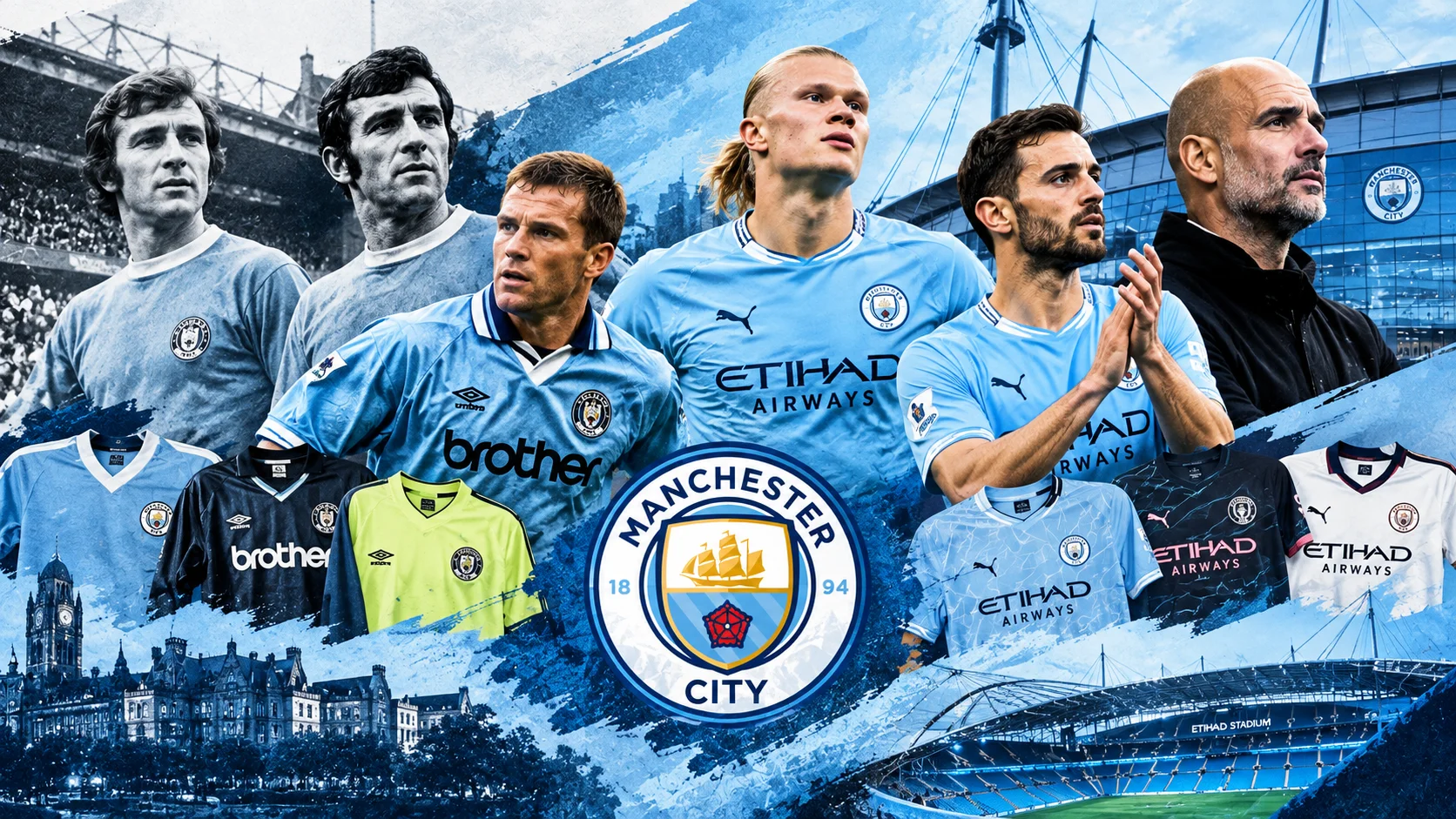
Manchester City’s jersey has been sky blue since the 1890s, and for most of that time it was worn by a club that won something roughly once a generation. The last fifteen years have changed the maths. City now have more league titles than any club except Manchester United, Liverpool and Arsenal, the sky blue is a global product, and the players who have worn it since 2008 are as famous as anyone in the game. This is a tour through the Manchester City jersey by era: the players, the manufacturers and the moments, from a 1968 title won in plain blue to a 2026/27 shirt that fades to white.
1968: Bell, Lee and Summerbee
The jersey’s first great team was Joe Mercer and Malcolm Allison’s, which won the league in 1968, the FA Cup in 1969 and the League Cup and Cup Winners’ Cup in 1970. Colin Bell, “Nijinsky”, wore the 8; Francis Lee wore the 9 and scored the penalties; Mike Summerbee wore the 7; Tony Book captained from the 2. They played in a plain sky blue shirt with a white crew neck and no branding of any kind, and the design is the one Puma has returned to more than once for anniversary kits. Bell’s stand at the Etihad and Lee’s later ownership of the club are reminders of how much that team shaped it.
1976 to 1981: Tueart, Umbro and Wembley
Dennis Tueart’s overhead kick won the 1976 League Cup final against Newcastle in an Umbro shirt, and the same manufacturer’s design was worn in the 1981 FA Cup final, the one City lost to Tottenham in a replay after Ricky Villa’s goal. The late-1970s jerseys, with their thin white pinstripes and V-necks, are the first City shirts to have been sold widely as replicas, and they remain popular with supporters who remember the club as a top-six side rather than a champion.
The 1990s: Kappa, Kinkladze and Gillingham
The decline of the 1990s produced City’s most affectionately remembered bad kits. Georgi Kinkladze wore the 10 in Umbro’s laser-blue designs of the mid-decade and in the baggy Kappa shirts of 1997 to 1999, and he was so good in so poor a team that the jersey is remembered for him rather than for the two relegations. Paul Dickov wore the 9 in the Kappa shirt at Wembley in May 1999, scored the 95th-minute equaliser against Gillingham in the Second Division play-off final and City won on penalties. It is the lowest point in the club’s history and, for those who were there, one of its best days.
2008 to 2013: Umbro, Etihad and 93:20
The takeover of 2008 changed the players who wore the jersey but not the jersey itself. Umbro returned in 2009, the Etihad logo arrived the same year, and the plain sky blue shirt of that period was worn by Yaya Touré for the 2011 FA Cup semi-final and final and by Sergio Agüero, in the 16, for the goal against QPR at 93 minutes and 20 seconds on 13 May 2012 that won the club’s first title in 44 years. That shirt, Umbro, Etihad, sky blue, is the most collected City jersey of all, and the club marks the moment on the stadium clock.
2013 to 2019: Nike and the 100 points
Nike made the jerseys for the titles of 2014, under Manuel Pellegrini, and 2018 and 2019, under Pep Guardiola. The 2017/18 shirt was worn for a season of 100 points, 106 goals and a record margin, by a team of Kevin De Bruyne in the 17, David Silva in the 21, Sergio Agüero in the 10 and Raheem Sterling in the 7. Vincent Kompany’s 4, worn for the header against Manchester United in 2012 and the shot against Leicester in 2019, is the defensive jersey of the era.
2019 to 2026: Puma, Haaland and the treble
Puma took over in 2019 and have produced the jerseys of the most successful period in the club’s history: four consecutive titles from 2021 to 2024 and the 2023 treble, completed with Rodri’s goal against Inter in Istanbul. Erling Haaland arrived in 2022, took the 9 and scored 36 league goals in his first season, a Premier League record. Rodri, in the 16, won the 2024 Ballon d’Or, the first City player to do so. De Bruyne left in 2025 after a decade in the 17. The 2025/26 season ended with the title lost to Arsenal, confirmed when City could only draw 1-1 at Bournemouth with a game to spare, but with both domestic cups won.
2026/27: the gradient
This season’s jersey is Puma’s boldest. The sky blue runs as a gradient from darker shoulders to a lighter hem, the crest and Etihad logo are in a metallic monochrome, and the phrase “Not Your Typical City” is printed inside the collar. It is worn with white shorts and socks. The away jersey is black and yellow with a bee pattern for the city of Manchester. Haaland keeps the 9, Phil Foden the 47, and the adult replica costs £85. Guardiola, in his eleventh season, has the longest current tenure of any Premier League manager.
The 1969 final in red and black
The sky blue was not worn for two of the club’s most important cup wins. Malcolm Allison, who believed stripes looked continental, had City wear red and black for the 1969 FA Cup final against Leicester, won by Neil Young’s goal, and again for the 1970 Cup Winners’ Cup final in Vienna against Górnik Zabrze, won 2-1 with goals from Young and Lee. The red and black stripes have returned as away and third kits in almost every era since, and are the change design supporters most associate with the club.
The number that was retired
City retired one number. Marc-Vivien Foé wore the 23 on loan from Lyon in 2002/03 and died during a Confederations Cup match for Cameroon in June 2003, and the club withdrew the number permanently. It is the only City shirt number that will not be worn again, and the club marks his memory at the Etihad. Every other number in the club’s history has been passed on, which is why Agüero’s 16 and Kompany’s 4 are now worn by others and judged against the men who made them famous.
What connects the eras
Lay out Bell’s 8, Kinkladze’s 10, Agüero’s 16, Kompany’s 4 and Haaland’s 9 and you have a club whose numbers belong to eras rather than to a single dynasty, which is what happens when a club spends forty years between titles and then wins six in seven seasons. The jersey has been the constant: sky blue, white trim, and a shade that no other major club in the world wears. Everything else about Manchester City has changed since 2008. The colour on the back of the numbers has not. For more Premier League history, kits and player analysis, explore AQ Football.