
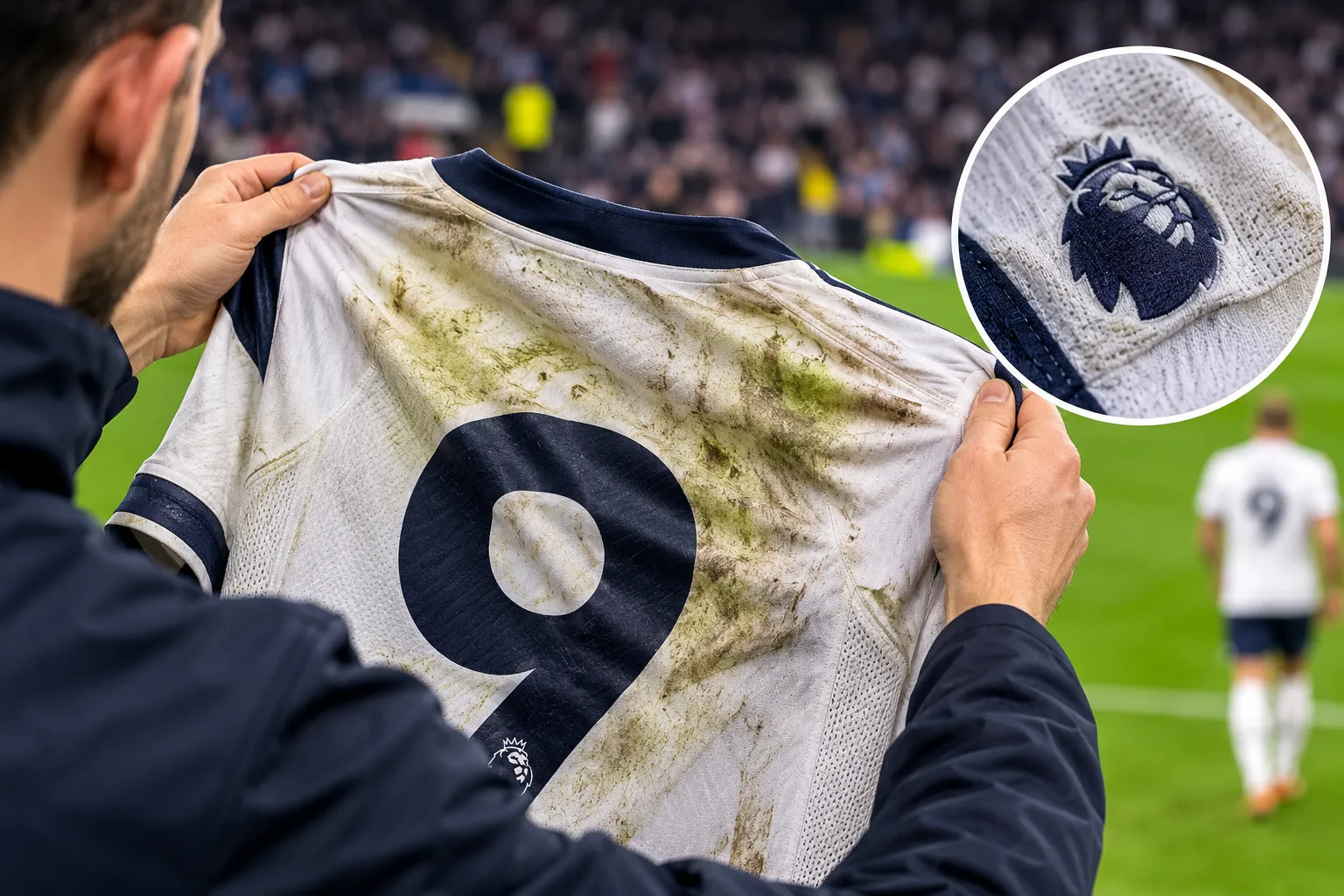
Learning how to check a football shirt is match worn matters because this is the corner of the market where the money is largest and the claims are loosest. A genuine match-worn shirt from a significant game can be worth many multiples of the retail version, and that gap attracts exactly the behaviour you would expect.
The useful thing is that match wear leaves evidence, and the evidence is hard to fake convincingly. What follows is what to look for and in what order.
Match worn, match issued, match prepared
Three terms, routinely conflated, and the price difference between them is enormous.
Match worn means the shirt was on a player during a match. Match issued means it was prepared for a specific match and allocated to a player who did not wear it — a substitute who stayed on the bench, or a spare from the kit room. Match prepared generally means the same thing and is sometimes used to blur the distinction deliberately.
A match-issued shirt is a genuine, interesting item and it is not the same product. Sellers who use “match issued” accurately are being honest; sellers who describe a match-issued shirt as match worn are not. If a listing uses the terms interchangeably, treat everything else in it with suspicion.
What actual wear looks like
Not just dirt. A shirt that has been through ninety minutes carries a specific pattern of evidence, and the absence of it is the first warning.
Look for stretching at the collar and shoulders, where shirts get pulled. Look for pilling under the arms and at the hem from contact. Grass and mud staining should sit where you would expect it — down one side, on the back, around the hem — rather than distributed evenly like something that has been dragged across a lawn deliberately.
Repairs are a strong positive indicator. Kit staff stitch small tears rather than discarding shirts mid-season, and a neat repair that nobody would add artificially is good evidence. So is a shirt that has clearly been washed many times, which shows in the fabric’s surface and in slightly faded printing.
What should worry you is a shirt in perfect condition described as worn in a famous match. Significant matches are physical, and shirts that played in them look like it.
What do the match-detail patches tell you?
In several competitions, shirts for a specific fixture carry details the retail version does not: a match-day patch with the date and the opponents, competition badges applied for that season only, sometimes a commemorative mark for a final or an anniversary.
Those are strong evidence when correct and damning when wrong. Check that the patch belongs to the competition, the season and the specific fixture claimed. A detail patch from the right season on a shirt claimed for the wrong match is a sign the shirt is genuine and the story is not.
Be aware that patches can be moved. A common manipulation is taking a genuine detail patch from a low-value shirt and applying it to a higher-value one, so look at the stitching or heat-bond around the patch and whether it matches the age of the surrounding fabric.
Why is photo-matching the real test?
Because every shirt is slightly unique once it has been worn, and photographs from the match record those irregularities. This is the gold standard in the hobby and the only method that produces genuine certainty.
What matchers compare: the exact position and angle of applied numbers and letters, which are never identical between shirts; pull marks and small snags; the way a specific crease or pattern irregularity sits; stitching anomalies. High-resolution match photography is detailed enough that a serious buyer can line up a shirt in hand against an image from the game.
It takes effort and it is worth it at any meaningful price point. A seller who refuses to let a shirt be photo-matched, or who cannot say which match it came from precisely enough to attempt one, is telling you something.
Certificates, and why most mean very little
A certificate of authenticity is only as good as whoever signed it. One issued by the club, with a traceable chain from the kit room, is meaningful. One issued by the dealer selling the shirt is a piece of paper asserting its own value.
The questions to ask are specific: who issued this, what was their access to the shirt, and what does the chain of custody look like between the match and now. A shirt that went from kit man to charity auction to a named collector to you has provenance. A shirt that arrived from “a private collection” has a sentence.
Club-run auctions, player foundations and official charity sales are the cleanest sources available, precisely because the chain starts with the club. Our seller checks guide applies here with higher stakes attached.
The paperwork that does help
Not all documentation is worthless, and it is worth knowing which kinds carry weight. A club-issued certificate naming the match and the player, produced by the club’s own auction or foundation, is the strongest available. A letter from the kit manager or a named club employee, with their role stated, is nearly as good.
Below that: an auction catalogue entry from a specialist house that examined the item, which at least means somebody with a reputation to protect looked at it. Then a documented chain through named collectors, each of whom can be contacted.
What carries no weight at all: an unsigned certificate, a hologram sticker with no issuing body, a photograph of the player in a shirt of that design, or the phrase “from a private collection” with no further detail. The last one is the most common and the least informative sentence in the entire market.
Shirt swaps and the volume problem
One more thing that confuses the market: players swap shirts after matches, routinely, and those shirts enter circulation through the receiving player rather than through either club. That is a legitimate route and it produces genuine match-worn shirts with unusual provenance.
It also means the total number of genuine match-worn shirts from any given fixture is small and fixed — two squads, a set each, some of which the clubs keep. When the market contains more claimed shirts from a famous match than were ever produced for it, and it frequently does, the arithmetic is the answer.
Before spending seriously, work out how many shirts could possibly exist from that match. It is usually a number in the dozens, and it is the most clarifying question in the whole process. For what any of it is actually worth, see how to value an old football shirt.
Frequently asked questions
What is the difference between match worn and match issued?
Match worn means a player wore it in a match. Match issued means it was prepared and allocated for a specific match but not worn. The price difference is substantial.
Should a match-worn shirt look dirty?
It should show wear consistent with use — collar and shoulder stretching, pilling, staining in plausible places, sometimes repairs. A shirt in perfect condition claimed for a significant match is a warning.
What is photo-matching?
Comparing the shirt in hand against high-resolution match photography, looking at letter and number placement, pull marks and stitching irregularities. It is the only method that produces real certainty.
Is a certificate of authenticity worth anything?
Only as good as its issuer. One from the club with a traceable chain of custody is meaningful; one from the dealer selling the shirt is not.