
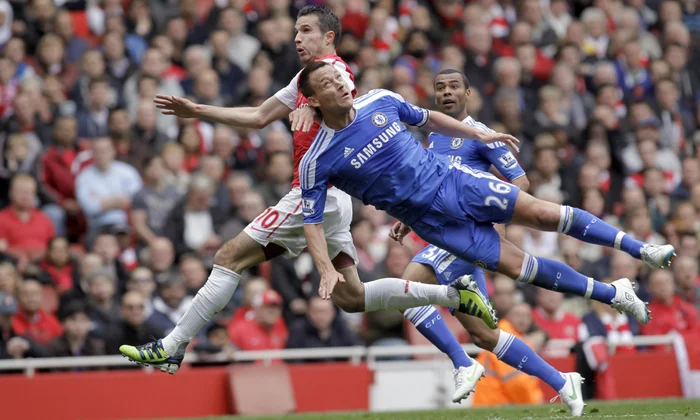
London has more professional football clubs than any other city in the world, and the derbies between them are a tangled web of history, geography and resentment. Arsenal against Chelsea is unusual within that web. For much of the twentieth century it was not a rivalry at all. It became one, quickly and intensely, within living memory, and it is now among the fixtures both sets of supporters care most about.
How that happened is a story about money, managers and a run of finals.
Were Arsenal and Chelsea always rivals?
No, and that is the first thing to understand.
Arsenal were founded south of the river in 1886 and moved north to Highbury in 1913. Chelsea were founded in 1905 in the west of the city. For decades the two clubs’ natural rivals lay elsewhere: Arsenal’s with Tottenham, their north London neighbours, and Chelsea’s with Fulham and the clubs around them. Arsenal and Chelsea met regularly, but the matches carried little beyond the points.
That changed when the two clubs found themselves competing for the same honours, which is how most non-geographical rivalries begin.
What turned it into a rivalry?
A shift in Chelsea’s status in the early 2000s, and the reaction it produced.
When Chelsea came under new ownership in 2003 and began spending on a scale English football had not seen, they moved into direct competition with the clubs that had dominated the previous decade, Arsenal among them. Arsenal had just gone through an entire league season unbeaten. Chelsea won the title the following year. The two clubs were suddenly fighting for the same trophies, and the fixture acquired an edge it had never had.
The managers made it personal. The contrast between the two men in the dugouts, their public exchanges and their very different ideas of how football should be played gave supporters something to argue about beyond the result.
Which matches defined it?
Finals, mostly, and the fixture has produced an unusual number of them.
The clubs met in the FA Cup final in 2002, with Arsenal winning. They met in the League Cup final in 2007, a match remembered as much for the brawl near the end as for Chelsea’s victory. They met in the FA Cup final again in 2017 and 2020, Arsenal winning both, and in the Europa League final in 2019, which Chelsea won comfortably. Few rivalries anywhere have been settled in so many showpiece matches, and each one added to the history.
The league meetings have had their moments too, including some heavy defeats in both directions that supporters on each side still bring up.
What separates it from London’s other derbies?
Distance and origin.
Arsenal’s rivalry with Tottenham and Chelsea’s with Fulham are neighbourhood derbies, built on proximity and mixed streets. Arsenal and Chelsea are several miles apart, and their supporters do not live on top of each other in the same way. The rivalry grew from competition rather than geography, which gives it a different flavour: less about local pride, more about which club is the bigger force in the capital.
That makes it closer in character to the rivalries between the northern giants than to a traditional derby. It is a rivalry about status.
Which players crossed the divide?
Enough to add another layer, and each move was received badly by the club left behind.
Several players have worn both shirts, and a move between the two is treated by supporters as something close to betrayal, in a way that a move to a northern club is not. The reaction is sharper because the two clubs compete directly for the same honours, and a player leaving one for the other is seen as choosing the rival. Those transfers, and the matches that followed where the player faced his former club, are part of the rivalry’s folklore.
What is the atmosphere like?
Hostile in a way that surprises people who know only the geography.
Because the rivalry is about status rather than neighbourhood, visiting supporters are not met with the same mix of familiarity and hostility that marks a true local derby. The reception is simply hostile. Both grounds are among the loudest in the capital for this fixture, and the away sections are full and vocal. For a neutral it is one of London’s better days out. For a supporter of either club it is closer to an ordeal.
How do the two clubs see each other?
Through very different self-images, which is part of the friction.
Arsenal’s identity is built on tradition, on a long history of success and on a particular idea of how football should be played. Chelsea’s modern identity was built fast, on investment and on winning quickly, and the club’s supporters have never much minded that. Each set of fans tends to see the other through that lens, and the stereotypes, fair or not, feed the rivalry.
Both clubs have also claimed London at various points, and the question of which is the capital’s biggest club is one neither set of supporters will concede.
How did the managers shape it?
More than any single player did.
The rivalry’s early years were defined by two managers whose approaches to football could not have been more different, and whose public comments about each other gave supporters a script. One built teams around patient, technical football and a long-term project; the other around pragmatism, immediate results and an open contempt for the alternative. Supporters took sides, and the sides outlasted both men.
Later managers inherited that framing. Each new appointment at either club was judged partly on how he would handle the other, and several have found that the fixture against the London rival defines their tenure as much as the title race does.
Does it still matter?
More than ever, since both clubs are usually competing for the same European places and the same cups.
The rivalry no longer depends on the two managers who first made it personal, or on any single season. It has outlasted several generations of players and coaches on both sides, which is the sign that a rivalry has become permanent rather than circumstantial. Supporters who were children when it began now bring their own children to the fixture.
Our piece on why home advantage still matters in the Premier League covers one reason these fixtures swing so sharply between the two grounds. And for the shirts worn in those finals, several of which have become collectors’ items, our look at when Premier League kits became football icons explains why.
That is the measure of it. A rivalry built in a decade, sustained by finals and managers, and now carried by supporters who do not remember a time when the fixture meant nothing.
Frequently asked questions
When did Arsenal and Chelsea become rivals?
Mainly from the early 2000s, when Chelsea’s new ownership put the club in direct competition with Arsenal for titles and trophies.
Have Arsenal and Chelsea met in finals?
Several times, including FA Cup finals in 2002, 2017 and 2020, the League Cup final in 2007 and the Europa League final in 2019.
Is Arsenal vs Chelsea a local derby?
Not in the traditional sense. The clubs are several miles apart and the rivalry grew from competition for honours rather than from geography.