
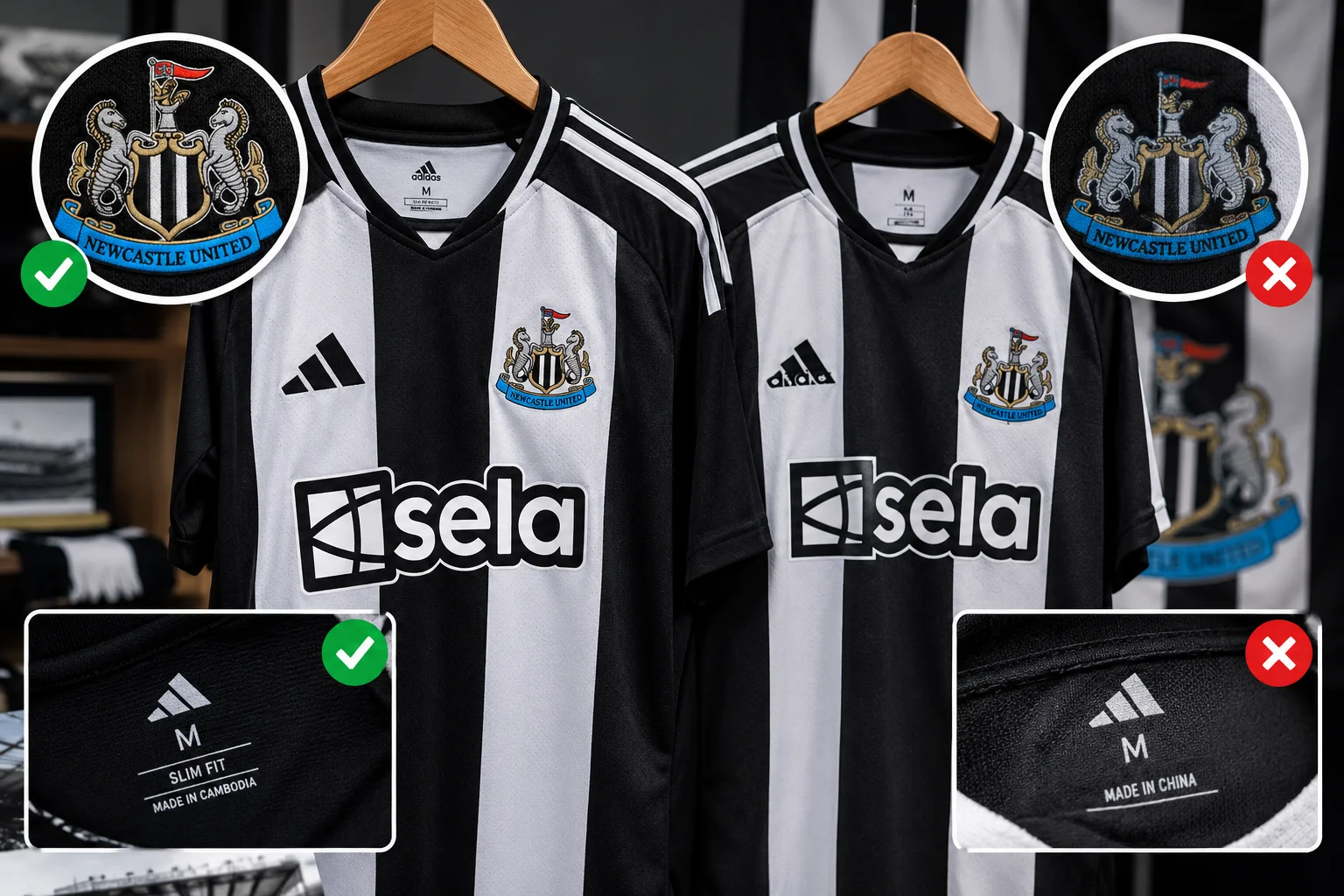
Vertical stripes are the hardest design in football to counterfeit well. Every seam has to line up, every stripe has to be the same width as the one next to it, and any error is visible from across a room. That makes Newcastle’s home shirt unusually easy to assess, which is useful because it is also one of the most widely copied kits in England.
The checks below work on any season from the last thirty years. None of them requires special equipment, and most can be done from good photographs before you part with any money.
Start with the stripes
Three separate things to look at. First, width consistency: on a genuine shirt every black stripe is the same width as every other black stripe, and the same is true of the white. Count them if you can, because a mismatch in stripe count against a photograph of the season is the clearest single giveaway.
Second, alignment at the seams. Where the front of the shirt joins the side panel, and where the body joins the sleeve, the stripes should continue without a step. On a counterfeit assembled from printed panels there is almost always a visible jump at one of those joins, usually under the arm where the maker assumed nobody would check.
Third, whether the stripes are knitted or printed. Stretch a black stripe gently between two fingers. On a properly made shirt the colour is part of the fabric and stays solid; on a printed fake the black thins and white shows through from underneath. This is the single most reliable test on a striped shirt and it takes two seconds.
The crest
Newcastle’s badge is detailed — a shield with a castle, flanked by seahorses, with fine linework throughout — and fine detail is what cheap embroidery destroys. On a genuine shirt the individual elements are distinct and the outlines are crisp. On a fake the stitching is dense and slightly raised, and the detail inside the shield reads as a blur.
Check the position too. The badge sits in a specific place relative to the stripes and to the centre line, and counterfeits frequently place it a centimetre or two off, or centre it on the wrong stripe. Compare against an official product photograph of the same season rather than against your memory.
What should the inside of the neck look like?
Turn the shirt inside out, because this is where most fakes fall apart. A genuine shirt has a neatly finished neck tape, clean overlocked seams, and labels that are stitched in squarely with legible printing. The size label, the wash-care label and any supplier authenticity tag should all be present and consistent with each other.
Look specifically for mismatches. A counterfeit will often have a size label from one season and a care label from another, or a product code that does not correspond to the shirt in front of it. Suppliers change their internal labelling regularly, so a genuine shirt’s labels are a reliable fingerprint of its year.
Loose threads, puckered stitching around the hem, and seams that are overlocked unevenly are all signs of a garment made quickly. Official kit is not perfect, but it is consistent.
The collar, cuffs and hem
Neck construction is expensive to get right, which makes it a dependable test. On a genuine shirt the collar is a specific designed component — ribbed, bonded, or a shaped crew depending on the season — and it holds its shape when you pull it gently and release it. A counterfeit usually uses a generic ribbed crew neck that stretches out of shape and does not recover.
Cuffs follow the same logic. Where a season’s shirt had a ribbed or elasticated cuff, a fake frequently substitutes a plain hemmed sleeve, because the ribbing is a separate piece of fabric and a separate operation. Check the sleeve ends against a product photograph of the season.
The hem is the quiet giveaway. Official shirts are hemmed evenly with a consistent stitch and, on many seasons, a slightly longer back than front. Counterfeits are often hemmed straight across and unevenly, and on a striped shirt you can see the hem cutting across the stripes at a slight angle if the panel was cut carelessly.
How do you check the printing?
If the shirt carries a name and number, the lettering is a strong test. Each league has an official font, and the shapes of the digits are specific enough that a wrong font is obvious when you see it next to the real one. Counterfeits frequently use a near-match that is slightly too narrow or too rounded.
Application matters as well. Official printing is heat-applied as a thin, flexible transfer that sits almost flush with the fabric. A fake usually uses a thicker vinyl that you can feel as a raised plastic layer, and that cracks at the edges after a few washes. Our guide to how shirt number fonts are chosen explains why the fonts are so distinctive in the first place.
Sleeve badges are the final check. Competition patches are licensed, made to a standard specification and applied in a set position. A sleeve patch that is slightly the wrong size, the wrong colour or crooked is a strong indicator, and it is one of the details counterfeiters get wrong most often because the patches are the hardest part to source.
Price, seller and the obvious signals
Genuine newcastle united shirts sell within a predictable range, and the current season’s home shirt in particular does not get heavily discounted while it is current. A listing well below the going rate for a brand-new current shirt is telling you what it is.
Beyond price, look at the listing itself. Photographs of the actual item rather than stock images, a clear returns policy, a seller with history, and a willingness to answer a question about the labels are all good signs. A seller who will not photograph the inside of the neck is not worth the risk. We cover the wider version of this in our seller checks for buying shirts online.
Frequently asked questions
What is the quickest way to spot a fake Newcastle shirt?
Stretch a black stripe. If white shows through, the stripes are printed on a white base rather than knitted into the fabric, which means it is not an official shirt.
Do the stripes line up on genuine shirts?
Yes. Stripes should continue without a step across the side seams and at the sleeve join. A visible jump at either point indicates panels cut from printed fabric.
Can a fake have the correct labels?
Sometimes, and the better counterfeits copy them closely. The usual failure is consistency — a size label, care label and product code that do not all belong to the same season.
Is a cheap current-season shirt always fake?
Not always, but a brand-new current home shirt at a large discount is unusual, because clubs and suppliers control pricing while a kit is current. Treat it as a reason to check the other details carefully. It is worth understanding how counterfeit football shirts are made before you buy from an unfamiliar seller.