
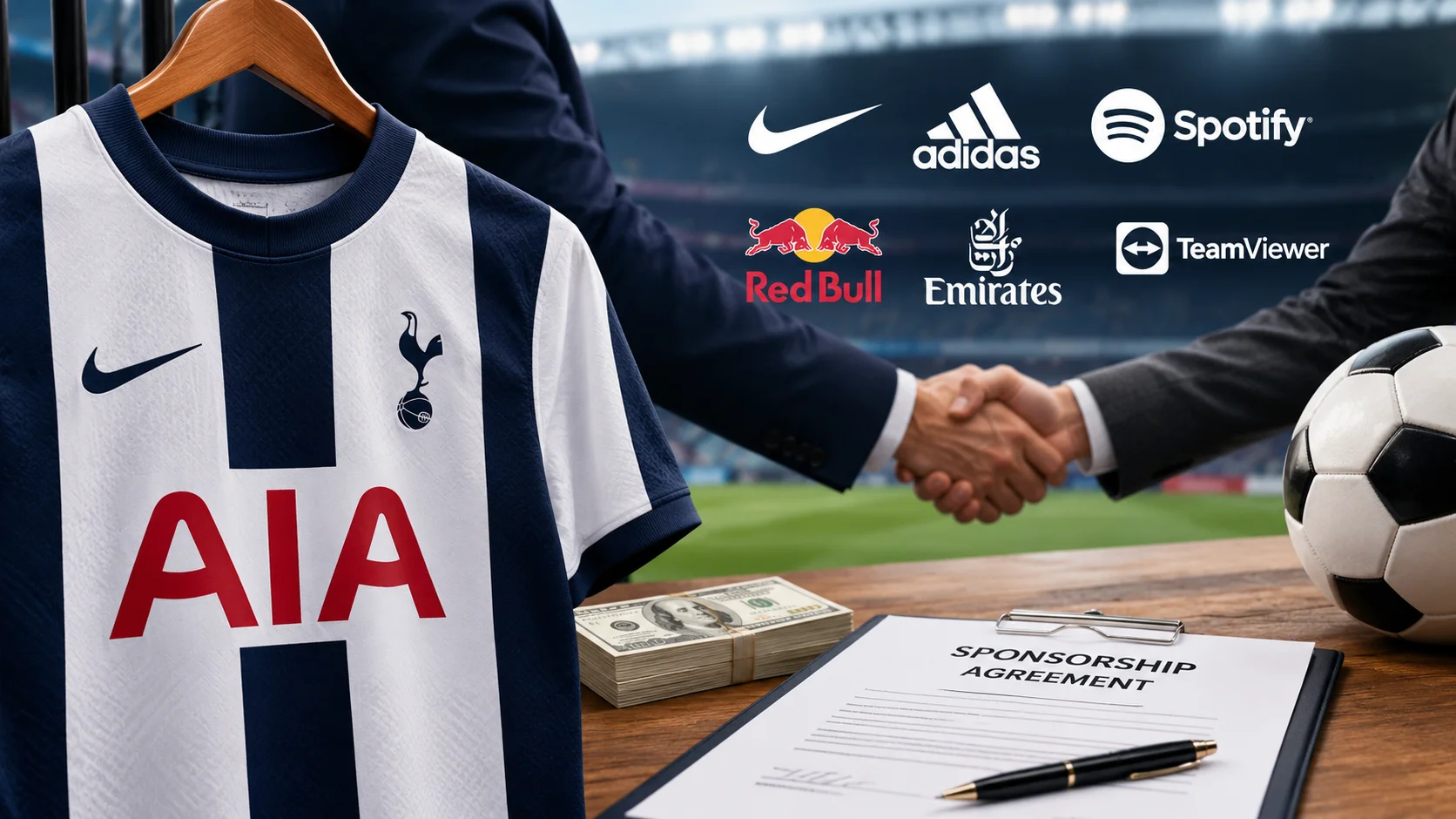
The name across the front of a football shirt is worth more than the shirt, the crest and the manufacturer’s logo combined, at least in commercial terms. Shirt sponsorship is the single most visible advertising space in sport, and the deals behind it shape club finances and, indirectly, the shirts supporters end up buying.
Here is how it works, and why it matters for anyone who collects or dates shirts.
What is a shirt sponsor paying for?
Visibility, mostly, and association.
A sponsor’s name on the front of a shirt appears in every match broadcast, every photograph, every replica sold and every highlight shown around the world. For a club with a global following, that is exposure on a scale few other advertising placements can match. The sponsor also gains association with the club’s identity and, for the biggest clubs, with success.
In return the club receives a payment, sometimes very large, that flows straight into its budget. For many clubs it is one of the largest single sources of income outside television.
How are the deals structured?
Usually as fixed annual payments over a term of several years, sometimes with bonuses.
A typical deal runs for three to five years, with the sponsor paying a set amount each season. Larger deals may include performance bonuses for trophies or European qualification, and some include clauses that adjust the payment if the club is relegated. The club and sponsor also agree what the sponsor can do with the association: use of players in advertising, hospitality at matches, and so on.
The value varies enormously. The largest clubs command deals worth tens of millions a season. Smaller clubs may receive a fraction of that, or in some cases supply kit sponsorship to a local business at modest cost.
When did shirt sponsorship start?
In English football, in the 1970s, and it was resisted at first.
The first sponsored shirts appeared in the late 1970s, and the football authorities were initially reluctant, with restrictions on the size of sponsor logos and on whether sponsored shirts could be worn in televised matches. Those restrictions fell away through the 1980s as the money became too significant to refuse, and by the 1990s sponsored shirts were universal.
Before that, shirts carried only the club crest and the manufacturer’s mark, which is why unsponsored shirts from the 1970s and earlier look so clean to modern eyes.
The value of a deal also depends on where a club’s supporters are. A club with a large following in a particular overseas market can attract a sponsor from that market at a price that would make no sense for a club followed only domestically. That is why some Premier League sponsors are companies almost unknown in Britain: they are buying exposure to an audience elsewhere.
Why are some sponsors controversial?
Because the association works both ways.
A club that takes money from a sponsor is lending that sponsor its reputation, and supporters have objected when the sponsor’s business conflicts with what they believe the club should stand for. Gambling companies, in particular, have drawn sustained criticism, and restrictions on their front-of-shirt presence have been agreed. Sponsors from certain industries or countries have also caused arguments.
Clubs balance the money against the reaction, and not always in the way supporters would prefer.
How do clubs choose a sponsor?
Money first, with reputation somewhere behind it.
Clubs run a sales process, often through an agency, inviting offers from companies that want the exposure. The largest offer usually wins, though clubs increasingly consider how a sponsor will be received by supporters and whether the association fits the club’s image. Some clubs have turned down larger offers from industries they judged would cause problems, and some have taken them and dealt with the consequences.
The negotiation also covers what the sponsor may and may not do with the club’s name and players, which can be as contentious as the money.
What about sleeve sponsors and training kit?
Additional deals, sold separately, and increasingly valuable.
Sleeve sponsorship was introduced in the Premier League in the late 2010s, giving clubs a second position on the shirt to sell. Training kit sponsorship is another separate deal, often with a different company, which is why the name on a club’s training tops frequently differs from the name on the match shirt. Some clubs also sell sponsorship of the back of the shirt in certain competitions, or of the shorts.
Each is negotiated on its own, and together they can add substantially to what the front-of-shirt deal brings in.
What happens when a sponsor leaves mid-deal?
Occasionally a sponsor withdraws early, through financial difficulty, a change of strategy or controversy, and the club has to respond quickly.
The usual result is a shirt worn for part of a season with a replacement sponsor, or with no sponsor at all, and those shirts become unusually collectable. A shirt worn for a handful of matches with a stopgap sponsor is rarer than almost anything else a club produces, and collectors track them closely.
For the club, an early exit is expensive, since the replacement is negotiated under pressure and rarely on terms as good as the original.
Why does the sponsor matter for dating a shirt?
Because sponsorship deals run in defined blocks, and the sponsor is often the quickest way to place a shirt in an era.
A shirt carrying a particular sponsor can only be from the seasons that sponsor was on the front. Combined with the manufacturer’s logo, which changes on a different cycle, the two together usually narrow a shirt to a small range of seasons. Shirts from short sponsorship deals are easiest to date and often the most collectable, since they exist for only a season or two.
Our guide to how football kit supplier deals work covers the manufacturer side of the same equation.
Do replica shirts always carry the sponsor?
Almost always, though not in every market.
The sponsor is part of the shirt’s design and appears on replicas as standard. Some shirts sold in particular regions carry a different sponsor for that region, or none, where advertising rules or commercial arrangements require it. Children’s shirts are sometimes produced without sponsors from restricted industries, particularly gambling, where rules prevent advertising to children.
A replica without a sponsor is not necessarily wrong, but it is worth understanding why before buying.
The wider point for collectors is that the sponsor is the shirt’s timestamp. Everything else on the front can be reproduced, but the sponsor on an original shirt ties it to a specific commercial relationship that existed for a specific period, and that is what makes it the first thing to check when a shirt claims to be from a particular season.
Frequently asked questions
How much do shirt sponsors pay?
It ranges from tens of millions a season for the largest clubs to modest sums at smaller ones, depending on the club’s audience and success.
When did football shirts start having sponsors?
In English football, the late 1970s, with restrictions on televised matches lifted through the 1980s.
Why do some children’s shirts have no sponsor?
Where the sponsor is from a restricted industry such as gambling, rules on advertising to children mean the sponsor is removed from kids’ versions.