
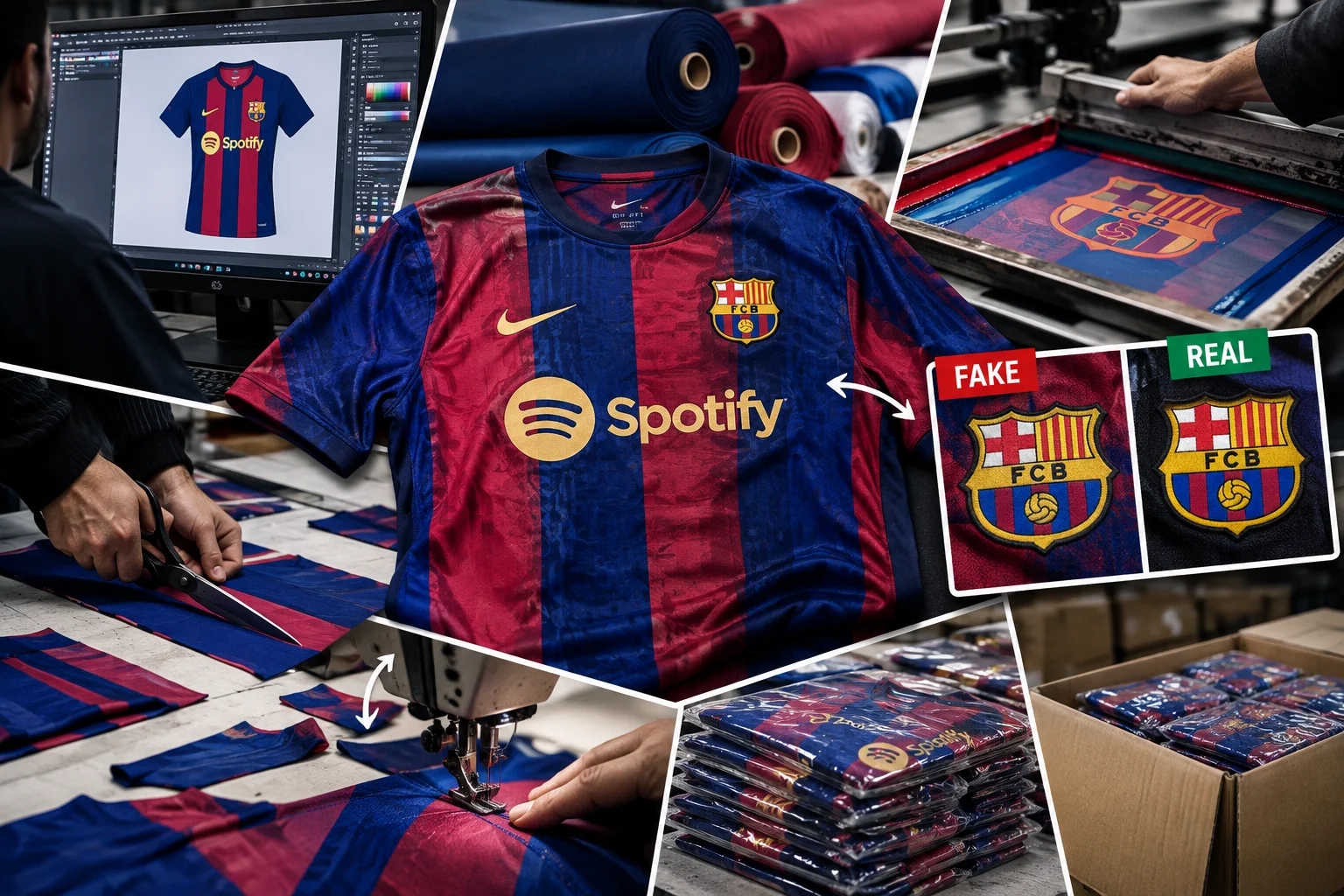
The word “fake” covers a very wide range of products. At one end there is a shirt that looks wrong from three metres away, with the stripes printed on and the badge a green blob. At the other there are shirts good enough that experienced collectors need to check the labels. Both are counterfeit, and understanding the difference is what makes you harder to fool.
The industry behind them is organised, tiered and surprisingly open about its own grading. Knowing how it works tells you which checks actually matter.
The three tiers
Counterfeit sellers themselves use a rough quality hierarchy, and the terminology varies but the tiers are consistent.
The cheapest tier is made from a generic blank — a plain polyester shirt in the base colour — with everything else printed or applied on top. The crest, the sponsor, the stripes if there are any, and the trim all go on as transfers. These are easy to identify and easy to avoid: the design sits on the surface rather than being part of the garment.
The middle tier uses a shirt knitted to approximately the right specification, with the pattern in the fabric rather than printed, and an embroidered badge. These are the ones that cause most problems for buyers, because at a glance they look right. The failures are in the fine detail: badge linework, stripe alignment, collar construction and label accuracy.
The top tier is made in a factory with access to the real specification, often using similar fabric and the correct trims. These are sold at prices close to retail and are frequently sold as genuine. They are rare enough that most buyers will never encounter one, and they are also the reason that “it looks and feels right” is not sufficient proof.
Where the specification comes from
The middle and upper tiers are not reverse-engineered from photographs. They are made by taking a genuine shirt apart, measuring every panel, matching the fabric and copying the trims. For a design with a repeating pattern, a counterfeiter can get the pattern close but rarely gets the panel layout right, which is why alignment at the seams is such a reliable test.
What counterfeiters cannot easily obtain are the licensed components: competition sleeve patches, official lettering and the supplier’s own security labelling. Those are produced under contract by specific manufacturers, and the fakes are made separately. This is why patches and printing are the weakest point of even a well-made counterfeit.
Why is the counterfeit market so large?
Because the margins are enormous and the risk to the seller is low. A shirt that costs a few pounds to make sells for twenty or thirty, and the seller is usually several jurisdictions away from the buyer and the brand.
Demand does the rest. Official kit prices have risen steadily, families buying for two or three children face a significant annual cost, and a shirt that looks close enough for a nine-year-old is an obvious temptation. Enforcement focuses on large-scale importers and on marketplaces rather than on individual buyers, which means the supply keeps finding routes to market. The Intellectual Property Office is the UK body responsible for this area and publishes guidance on counterfeit goods and reporting.
Marketplace platforms are the other half of the story. Most counterfeit shirts now reach UK buyers through online marketplaces and social media rather than through market stalls, because a listing costs nothing and can be replaced within hours of being removed. Brands and leagues spend heavily on takedown operations, and the sellers treat that cost as routine, simply reappearing under a new account with the same stock.
Is buying a fake actually a problem?
Legally, buying a counterfeit for personal use is not generally prosecuted in the UK; selling one is a different matter entirely, and so is importing in quantity. The practical problems are more mundane.
Fakes do not last. The printing cracks, the badge frays, the fabric pills and the colour fades unevenly, usually within a season. The fabric performance is not there either, which matters if the shirt is going to be played in. And there is no recourse — no returns, no warranty and no way to resolve a sizing problem.
There is also a supply-chain point that gets made less often than it should. The upper tiers of this industry are produced in factories with no accountability for conditions or materials, which is a reasonable thing to weigh when the saving is twenty pounds.
The grey area: unlicensed retro and tribute shirts
Not everything that is unofficial is a counterfeit, and the distinction matters for retro buyers. A large number of vintage-style shirts are sold as tributes rather than reproductions: the right colours, the right pattern, the right era, but no club crest, no sponsor and no supplier branding.
Those are legal products, and some are very well made — often better than the licensed reproductions, because the maker is competing on fabric and construction rather than on the badge. If you want a shirt that evokes a season rather than replicates it, they are a genuine option and considerably cheaper.
What makes a shirt counterfeit is the use of the marks: the crest, the club name, the supplier logo and the sponsor. A tribute shirt that adds a club badge has crossed that line regardless of how it is described in the listing, and sellers who add badges on request are selling counterfeits whatever the product page says.
What this means for how you check
Three practical conclusions. First, check the construction before the appearance: how the pattern is made, how the seams align, how the neck is finished. Appearance is the easiest thing for a counterfeiter to get right and the construction is the hardest.
Second, concentrate on the licensed parts. Sleeve patches, official lettering and supplier security labelling are produced under contract and are the components fakes most often get wrong.
Third, treat the seller as part of the product. A seller with a trading history, clear photographs of the actual item and a returns policy is worth paying a little more for, because the alternative is no protection at all. The same principles apply to retro reproductions, which we cover in how to judge a Leeds reproduction.
Frequently asked questions
Are some fake shirts made in the same factories as real ones?
It happens, and those are the hardest to detect. They are also rare and sold near retail price, so most buyers encountering a cheap shirt are dealing with a lower tier.
Is it illegal to buy a fake football shirt in the UK?
Buying for personal use is not generally prosecuted. Selling counterfeit goods, or importing them in commercial quantities, is a criminal offence.
What is the hardest part of a shirt to counterfeit?
The licensed components — competition sleeve patches, official name and number lettering, and the supplier’s own security labelling. These are made under contract and fakes reproduce them poorly.
Do fake shirts wear out faster?
Considerably. Printing cracks, badges fray and fabric pills within a season in most cases, and the technical performance of the fabric is usually absent. Prices on genuine kit follow their own cycle, which we explain in how the replica kit market works.