
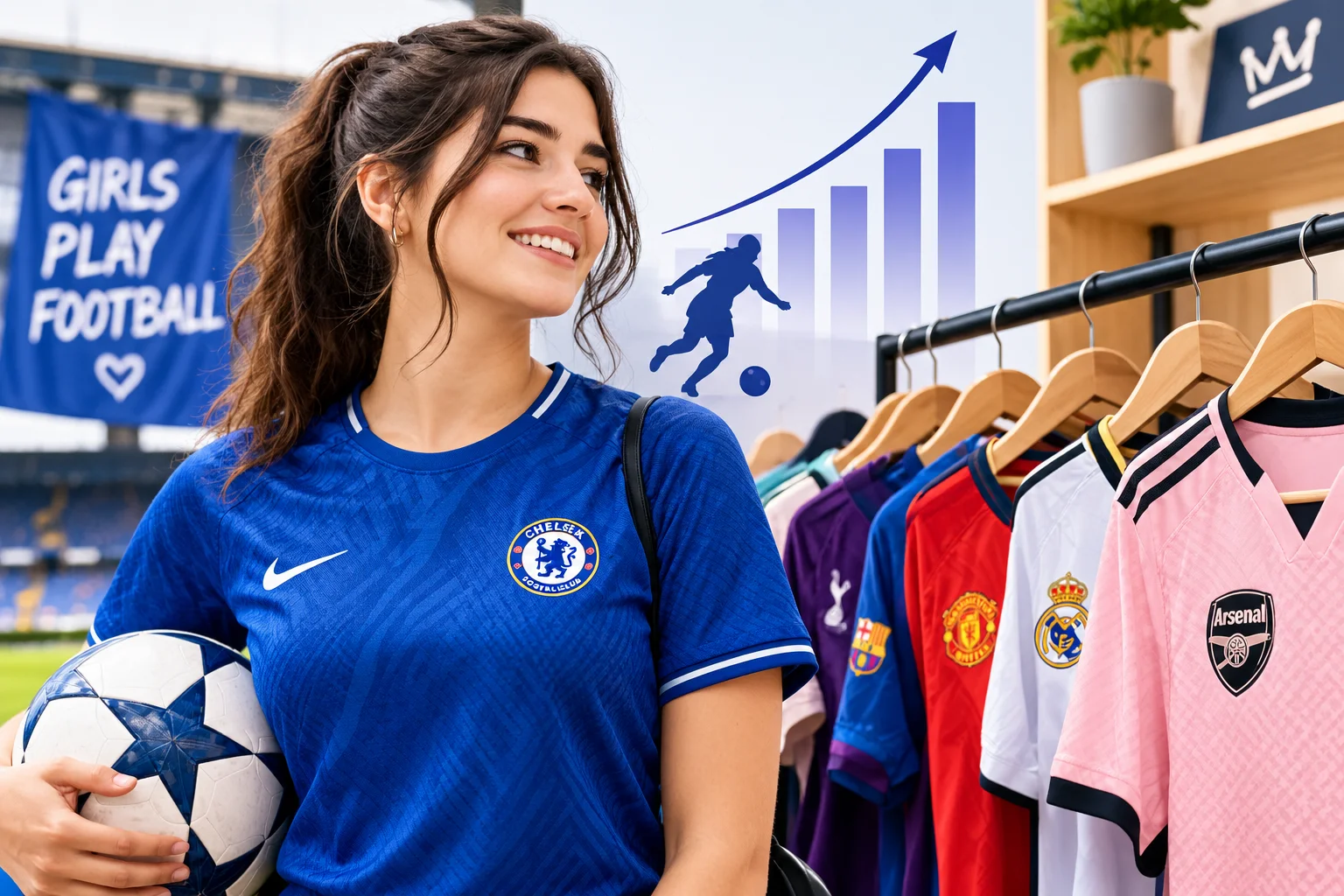
For most of its history, women’s football kit was not really designed at all. Players wore smaller versions of men’s shirts, or men’s shirts in small sizes, and the idea that a women’s kit might be built differently barely registered. That has changed, driven by the growth of the women’s game and by a market that finally recognised women both play football and buy shirts. The story of how women’s football shirts grew up says something about how the whole game has changed.
What was wrong with the old approach?
It treated women’s kit as men’s kit, shrunk.
For years, women’s teams wore kit designed for men, simply made in smaller sizes. That ignored the fact that a shirt cut for a man’s proportions does not fit a woman’s well, and that the replica market for women and girls was being served with products designed for someone else. It was not hostility so much as neglect: the women’s game was small, the market was assumed to be small, and nobody thought it worth the investment.
The result was kit that fit poorly and a replica market that offered women little designed for them, which in turn suggested the game did not take its own players or supporters seriously.
When did it change?
As the women’s game grew, and the market followed.
The rapid growth of women’s football, in participation, attendance and television, changed the economics. Suddenly there was a real and growing market for women’s and girls’ replica kit, and manufacturers had a commercial reason to design for it properly. Women’s teams began wearing kit cut for women rather than scaled-down men’s shirts, and replica ranges expanded to offer women’s fits alongside the standard unisex ones.
The change was commercial as much as principled, but the effect was the same: the women’s game got kit designed for it, and supporters got shirts designed for them.
What does a proper women’s shirt involve?
A different cut, mostly, built on the same fabric technology.
A women’s-fit shirt is cut to different proportions than a men’s or unisex shirt, through the shoulders, the chest and the waist, to fit better. The fabric technology is the same as any modern shirt, the engineered knits and ventilation that all performance kit uses, but the pattern it is cut to is different. For players, a better-fitting shirt is a genuine performance matter, since a poorly fitting kit is a distraction and a drag. For supporters, it is simply the difference between a shirt that fits and one that does not.
Many ranges now offer a choice: a women’s fit, a men’s fit and a unisex option, so buyers can choose what suits them rather than being forced into one.
Does the fabric differ at all?
Barely, and that is the point.
Women’s performance shirts use the same engineered knits, the same wicking fabric and the same ventilation as any modern kit, because the demands of playing are the same. The difference is entirely in the cut, not the material. Early assumptions that women’s kit could be a cheaper, simpler product were wrong, and the shirts that players and supporters wanted were ones built to the same standard as the men’s, in a fit that actually suited them.
That equivalence matters. A women’s kit built to a lower spec would carry the old message in a new form, and the market has learned that the women’s game expects, and deserves, the same quality.
Did the shirts themselves change?
Beyond the fit, the women’s game started getting its own designs.
For a long time, women’s teams wore the men’s team’s kit. Increasingly, women’s teams have their own kit designs, or variations that acknowledge the women’s team as a distinct entity rather than an appendage of the men’s. That shift, from wearing the men’s kit to having your own, mirrors the women’s game’s broader move from the margins to a game taken seriously in its own right.
It matters symbolically as much as practically. A team with its own kit is a team that exists in its own right.
What about kit for girls?
The same shift, and arguably more important.
As women’s and girls’ participation in football grew, the lack of properly designed kit for girls became harder to justify. A girl playing football in a boy’s kit receives the same quiet message the women’s game received for years: that she is an afterthought. Ranges now increasingly offer girls’ sizes and fits, and replica shirts cut for girls, which matters for the same reason the adult women’s kit does. Kit designed for you is a sign you are expected to be there.
The growth of the girls’ game has made this a real market rather than a gesture, and the manufacturers have followed it as they followed the adult women’s game.
Why did it take so long?
Because the market was underestimated, repeatedly.
The assumption that women’s football was a niche with a niche market was wrong, and the speed at which the women’s game and its commercial side have grown has surprised nearly everyone, including the people selling the kit. The delay in taking women’s shirts seriously was a delay in taking the women’s game seriously, and the two corrected together.
The lesson the market learned is one it keeps having to relearn: the audience for football is larger and broader than the people selling to it assume. Our piece on how football shirt sponsorship works covers the commercial side that now takes the women’s game seriously as a market in its own right.
The direction is clear and unlikely to reverse. As the women’s game keeps growing, the kit designed for it will keep improving, and the years when a women’s shirt meant a men’s shirt in a small size will look like what they were: a market that had not yet caught up with its own audience.
Frequently asked questions
What is a women’s-fit football shirt?
A shirt cut to women’s proportions through the shoulders, chest and waist, rather than a scaled-down men’s shirt. The fabric technology is the same; the pattern it is cut to is different.
Did women’s teams used to wear men’s kit?
Yes. For most of the game’s history women’s teams wore the men’s team’s kit in smaller sizes, and only as the women’s game grew did they get kit designed and cut for them.
Can I buy a women’s-fit replica shirt?
Increasingly, yes. Many ranges now offer a women’s fit alongside men’s and unisex options, so buyers can choose what suits them.